
Review · BARCELONA
Barcelona El Raval Dark History Walking Tour
Barcelona’s El Raval Dark History Walking Tour takes you past forgotten churches, old hospitals, crime scenes, and rough-edged streets that most first-time visitors miss. The stories range from the foundling wheel for unwanted infants to the so-called Vampire of the Raval, then continue toward the old nightlife district along Paral·lel.
I like the small group limit of 15, which gives the guide room to talk with you rather than shout at a crowd. I also like the route’s mix of social history, architecture, local crime, and street art. The main drawback is that the tour is built around stories and exterior sights, not long interior visits, so readers wanting major museum access may find it light.
Key points to know before booking
- Two hours from central Raval to Paral·lel: The route moves steadily across several neighborhoods and finishes at Jardins de les Tres Xemeneies.
- Dark stories with plenty of context: Crime, abandoned infants, autopsies, monastery violence, and old nightlife are balanced with art and city history.
- A maximum of 15 people: This is a useful size for questions, conversation, and keeping close to the guide on narrow streets.
- Guides with strong personal style: Eoghan is repeatedly praised for his humor and storytelling, while Zeynep, Callum, Andres, and Cal have also led engaging walks.
- A good first or final Barcelona tour: It helps you understand an area you might otherwise skip and can supply restaurant and sightseeing suggestions.
- No lunch or attraction admissions included: The $33.42 price pays for the guided walk, not meals or paid entry.
Why El Raval makes a strong setting for a dark-history walk
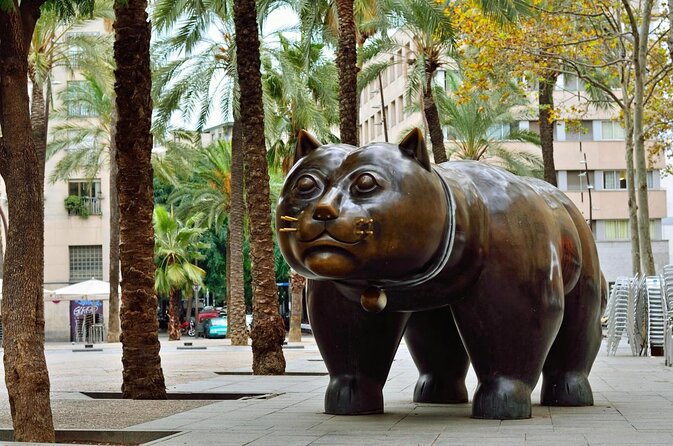
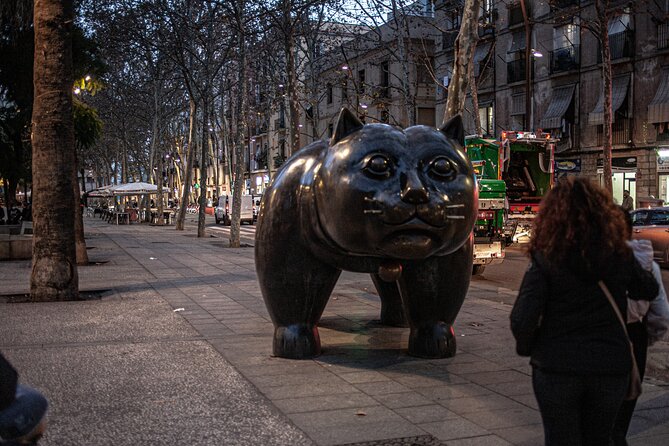
El Raval is one of Barcelona’s most layered districts. Its streets sit just west of the famous Gothic Quarter, but the mood and stories change quickly. Instead of focusing on grand monuments, this tour looks at institutions, crimes, poverty, religion, industry, migration, and entertainment.
That gives you a more useful picture of the city. Barcelona is not only Gaudí facades and sunny squares. Its past also includes hospitals that handled autopsies, religious houses with violent episodes, children abandoned at a church door, and a nightlife zone once known for gambling, theaters, brothels, and crime.
I appreciate that the tour does not treat the darker material as a cheap horror show. The route connects individual stories to the way Barcelona grew and changed. You hear about people and places, but also about social rights, art, industry, and the forces that shaped Raval.
The tone can vary with the guide. Eoghan is often singled out for his warmth, humor, passion for Barcelona, and ability to make a group feel at ease. Zeynep, Callum, Andres, and Cal have also led the walk, so the exact delivery will depend on the day. The consistent theme is an informal, story-led introduction to an overlooked part of the city.
More Dark History Tours in Spain
- Barcelona: Dark History Night Walking Tour
★ 4.8 · 344 reviews - Barcelona’s Dark History Night Tour
★ 5.0 · 181 reviews - Barcelona Dark History Night Walking Tour With Drinks
★ 5.0 · 153 reviews
Starting beside Sant Pere Nolasc Mercedaris
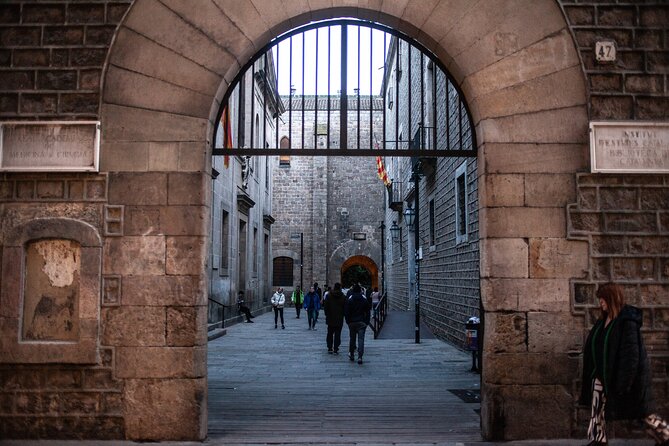
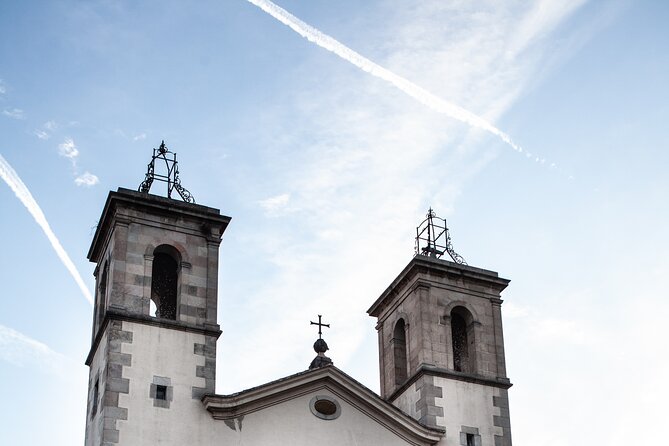
The meeting point is Parròquia de Sant Pere Nolasc Mercedaris at Plaça de Castella, 6. This puts you near the northern edge of the route, close to public transportation and within the central Ciutat Vella area.
The church is important from the start because it gives the tour a real sense of place. You are not simply meeting at a generic street corner and walking to a list of unrelated sights. The route begins with a religious building tied to the district’s changing identity, then moves into stories about institutions and people who lived around it.
You should arrive ready for a full walking tour rather than a series of rides between stops. The activity lasts about two hours, and the route ends well south of the start point. That makes the walk useful for seeing the city in motion, but you should allow extra time afterward if you have a reservation across town.
The foundling wheel at Casa de Misericòrdia
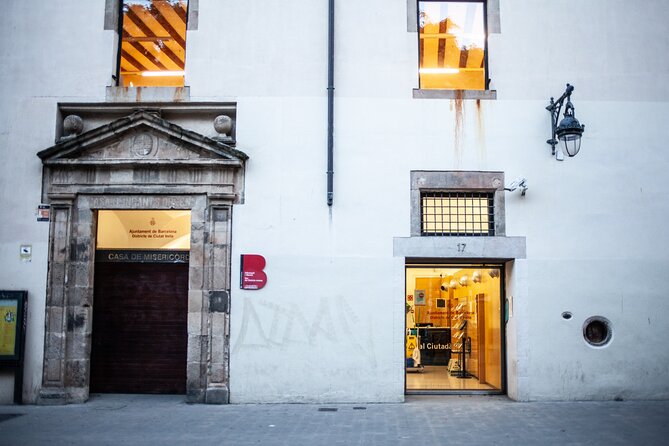
The first stop is the Fundació Privada Casa de Misericòrdia de Barcelona, where the guide explains the old foundling wheel. This device allowed parents to leave unwanted infants anonymously with a religious or charitable institution.
It is an unsettling story, but an important one. The wheel opens a window onto poverty, social pressure, religion, and the limited choices available to families in earlier Barcelona. It also shifts the idea of dark history away from famous killers and toward the quieter suffering built into city life.
You will spend about 20 minutes here, with no admission fee. Expect the guide to point out where this piece of history is hidden in plain sight rather than take you into a paid attraction.
This is a good example of what the tour does best. You pass a building that could seem ordinary, then learn why its doorway mattered. You begin looking at Raval less as a collection of streets and more as a record of how Barcelona cared for, controlled, or neglected its people.
Carrer de Joaquín Costa and the Vampire of the Raval
The next stop brings the tour into the darker crime stories associated with Carrer de Joaquín Costa. This is where you hear about the woman known as the Vampire of the Raval, described as Barcelona’s own Jack the Ripper.
The nickname gives the story an immediate hook, but the value lies in the surrounding detail. A good guide can explain how sensational crimes become part of a neighborhood’s identity and how legends can obscure the real people involved. Eoghan’s storytelling is especially well suited to this kind of stop, since his humor and expressive style are frequently praised.
Do not expect a crime-scene recreation or a haunted-house performance. The appeal is hearing the story in the actual streets where the district’s rough reputation developed. The material may be uncomfortable, so I would think twice before booking if you want a gentle architecture walk.
At the same time, the tour does not present Raval as dangerous or frozen in its past. One useful point is that the district has changed, and you are seeing a living neighborhood rather than a museum of old crimes.
More Ghost Walking Tours in Spain
- Barcelona: Gothic Quarter Ghosts and Legends Walking Tour
★ 4.7 · 1,443 reviews - Barcelona Ghosts of a Dark Past Gothic Walking Tour
★ 5.0 · 55 reviews - Barcelona: El Born Ghost Walking Tour.
★ 4.0 · 54 reviews - Barcelona: El Born Ghost Walking Tour
★ 3.8 · 47 reviews
The former Santa Creu hospital and its autopsies
At the Real Academia de Medicina de Cataluña, the guide discusses the former Hospital de la Santa Creu. The stop focuses on its connection with autopsies, which adds a medical and institutional side to the tour.
This is one of the route’s strongest history stops because it moves beyond folklore. Hospitals reveal how a city dealt with illness, death, education, and scientific study. The subject is grim, but it helps explain why old Barcelona could feel both deeply religious and increasingly interested in medicine and anatomy.
The stop lasts about 20 minutes and does not include an admission ticket. That means the experience depends on the guide’s explanation and your view of the exterior or surrounding area. If you want to enter the academy or see an interior collection, check separately because that is not part of this walk.
You may also notice the balance in the route here. The tour can tell a macabre story, then place it inside the development of Barcelona’s public institutions. That approach makes the two hours feel more substantial than a string of ghost tales.
Sant Pau del Camp and a monastery’s violent past
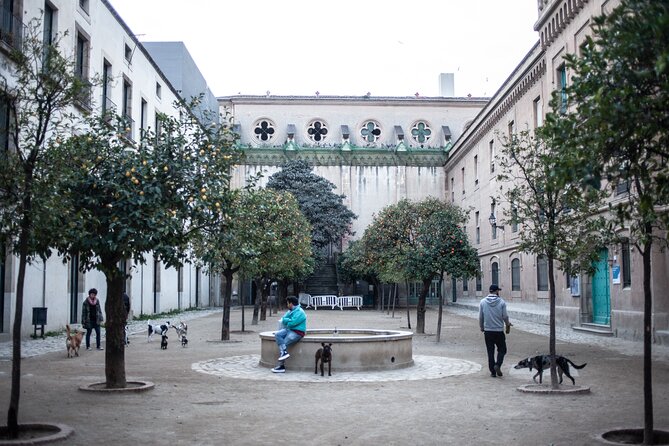
Sant Pau del Camp is one of the architectural highlights. It is described as Barcelona’s oldest church and was once a monastery. The church’s age and compact setting give the guide a chance to discuss early religious life and the violence that touched the monastery.
This stop is especially useful if you want historic buildings without signing up for a formal church tour. You see a place with genuine architectural weight, but the talk focuses just as much on what happened around it as on decorative details.
The church also gives the route some visual variety. Raval is not only narrow urban streets and graffiti. It includes old religious foundations, unusual facades, and traces of earlier city walls and institutions.
Again, the standard format is about 20 minutes with no admission fee listed. You should expect an outdoor explanation rather than guaranteed interior access. If Sant Pau del Camp is a priority, confirm what the guide plans to show on your date.
Avenida del Paral·lel and the old Chinese district
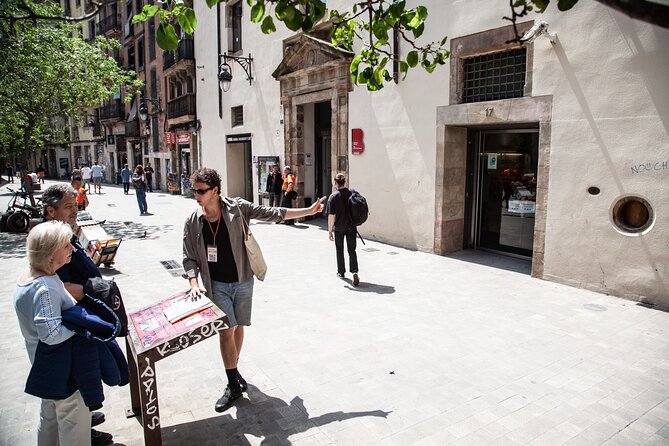
The route then heads toward Avenida del Paral·lel, once associated with the Chinese district and with Barcelona’s seedier 20th-century nightlife. The name refers to a historic entertainment area, not a modern tourist label, and the guide uses it to explain a different side of the city’s social life.
This section brings theaters, clubs, nightlife, and urban reputation into the story. It helps you understand why certain streets attracted performers, workers, gamblers, and people looking for entertainment outside respectable society.
I like this stop because it connects the older Raval stories with the city you see today. Barcelona’s nightlife did not appear from nowhere. It grew from specific streets, venues, and social habits that changed over time.
The tour description also promises a look at hidden clubs and squares like a local. That does not mean you enter a club during the walk. It means the guide points out places and explains how the area functioned, giving you ideas for further exploring after the tour.
Three Chimneys Gardens and Barcelona’s industrial edge
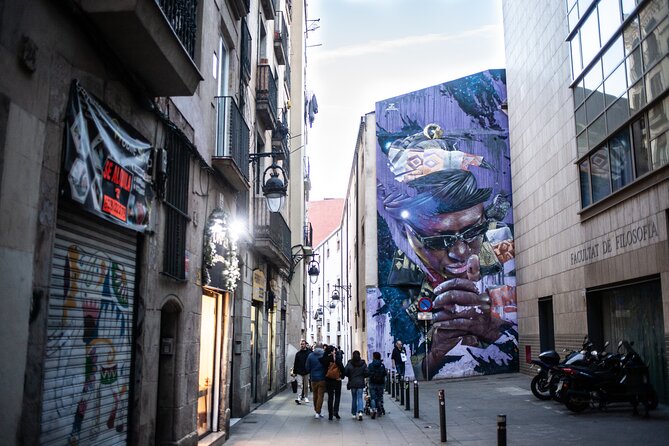
The walk ends at Jardins de les Tres Xemeneies, or Three Chimneys Gardens, on Avenida del Paral·lel. The park occupies a former industrial setting, and its three tall chimneys preserve that connection.
This is a smart finish. After churches, crime, hospitals, and nightlife, the route ends with industry and public art. The gardens are now known for graffiti, making the final stop feel connected to the present rather than locked in the past.
If you enjoy street art, allow a few extra minutes after the tour to look around. The experience ends at Plaça de Les Tres Xemeneies, not back at the starting church, so you can continue south toward Sants-Montjuïc or make your own plans around Paral·lel.
The endpoint also makes the tour practical as part of a larger day. You can pair it with other activities in the area, but remember that the tour itself does not include lunch. Bring water and plan your meal separately.
How the two-hour format affects the experience
Two hours is enough time to cover the six main locations without turning the walk into an exhausting half-day outing. Each stop is planned for roughly 20 minutes, though the actual pace can change with questions, street conditions, and the guide’s style.
The advantage is focus. You get a clear route and a series of memorable stories, rather than a long list of minor facts. The small group limit of 15 should also make it easier to hear and ask questions, especially near traffic or in narrow streets.
The trade-off is limited time at each site. You will not receive a full architectural lecture on every church, nor will you linger at each location for photographs. The tour works best as an introduction that helps you decide where to return later.
I would book it early in a Barcelona stay if possible. The walk gives you useful orientation, introduces streets you might not find alone, and can help you choose where to eat or explore afterward. It also works at the end of a trip, when you want to see a less polished side of the city before leaving.
Is $33.42 a fair price?
At $33.42 per person, the tour is not the cheapest way to walk through Raval. You could visit the streets and churches on your own for little money. The price pays for the guide’s research, route planning, storytelling, and ability to connect scattered places into one clear story.
That value depends heavily on how much you enjoy guided interpretation. If you prefer to read plaques and wander independently, the cost may not feel necessary. If you want context for what you are seeing, two hours of focused guidance is a reasonable use of your sightseeing budget.
The 4.9 rating from 70 reviews and 99 percent recommendation indicate very strong satisfaction, but I would still judge the experience by your interests. The praise centers on guide personality, storytelling, humor, safety, cultural context, and useful suggestions for places to eat and visit. Those are exactly the features that matter most on a walking tour.
No lunch, paid admissions, or other extras are included. That keeps the price clear, but you should budget for food and any return visits to places that catch your attention.
Who should book this walk
I would recommend the tour to you if you want more than Barcelona’s headline sights. It suits first-time visitors who want to understand Raval, repeat visitors who have already seen the major monuments, and anyone interested in crime, medicine, religion, social rights, nightlife, or street art.
It is also a good fit if you like guides with a personal style. Eoghan is praised for his charm, humor, energy, and passion for the city. Zeynep, Callum, Andres, and Cal have also been described as engaging and well prepared. Since guide assignments can vary, expect a strong host but not a specific person unless your booking confirms it.
I would skip it if you want a major attraction tour with guaranteed interior access. You should also avoid it if dark stories involving abandoned infants, violent crime, autopsies, and rough nightlife are not your idea of a pleasant afternoon.
The walk is generally accessible to most people, service animals are allowed, and it is near public transportation. You still need to be comfortable walking for about two hours and moving between six locations.
Booking, cancellation, and practical details
You receive confirmation when booking, and the ticket is mobile, so you do not need to print anything. The start point is Parròquia de Sant Pere Nolasc Mercedaris at Plaça de Castella, 6. The finish is Jardins de les Tres Xemeneies at Avenida del Paral·lel, 49.
Free cancellation is available until 24 hours before the start time for a full refund. Changes or cancellations inside that 24-hour window are not accepted for a refund. The operator also requires a minimum number of participants, so if that number is not reached, you are offered another date or experience, or a full refund.
The tour is often booked about 21 days ahead. That is a useful planning clue, especially if you want a particular date or hope to join a small group. I would wear comfortable shoes, keep your phone charged for the mobile ticket, and leave room in your schedule after the end point.
Should you book the Barcelona El Raval Dark History Walking Tour?
Book it if you want Barcelona explained through its less polished streets. The strongest parts are the guide-led stories, the small group size, the shift from religious institutions to crime and medicine, and the finish among industrial chimneys and graffiti.
I would treat it as a history and neighborhood orientation walk, not a ghost tour or museum visit. At $33.42, it offers good value for a well-told two-hour route, especially with a guide such as Eoghan, Zeynep, Callum, Andres, or Cal. If you are curious about how Barcelona’s social past shaped Raval and Paral·lel, this is a smart addition to your itinerary.
FAQ
How long does the Barcelona El Raval Dark History Walking Tour last?
The tour lasts approximately two hours. It includes six main stops, with about 20 minutes planned at each location.
Where does the tour start?
The meeting point is Parròquia de Sant Pere Nolasc Mercedaris at Plaça de Castella, 6, in Barcelona’s Ciutat Vella district.
Where does the tour end?
The walk ends at Plaça de Les Tres Xemeneies, Avenida del Paral·lel, 49. The endpoint is Jardins de les Tres Xemeneies.
What is included in the price?
The price includes an experienced local guide and the walking experience. The ticket is mobile, and the listed stops have no admission charge.
Is lunch included?
No. Lunch is not included, so you need to arrange food separately.
Can I cancel the tour for a refund?
Yes. You can cancel at least 24 hours before the start time for a full refund. Cancellations or changes made less than 24 hours before the start time are not accepted for a refund.
More Ghost Walking Tours in Barcelona
- Barcelona: Ghosts of a Dark Past Walking Tour
★ 5.0 · 10 reviews - Walking Tour Mysteries and Legends of Barcelona and its Ghosts
★ 5.0 · 3 reviews - New Orleans Premier Ghost, Voodoo and Vampire Walking Tour
★ 4.5 · 12,856 reviews - London: The Original Jack the Ripper Walking Tour
★ 4.7 · 7,833 reviews
More Dark History Tours in Barcelona
- Barcelona: Gothic Quarter Tour Dark History & Ghosts Tour
★ 4.8 · 64 reviews - Barcelona’s Dark History Walking Tour in El Raval
★ 4.8 · 6 reviews - Dark History and Legends Night Walk of Gothic Quarter
★ 5.0 · 2 reviews - Adults-Only New Orleans Ghost, Crime, Voodoo, and Vampire Tour
★ 5.0 · 6,545 reviews
Freshly reviewed haunts around Barcelona
- Walking Tour Mysteries and Legends of Barcelona and its Ghosts★ 5.0 · 3 reviews
- The Gothic Trail – Ghosts of Barcelona Exploration Game★ 4.5 · 33 reviews
- Witch Hunt on Montjuïc: Self-Guided Puzzle Quest in Barcelona★ 4.5 · 9 reviews
- Barcelona Ghosts of a Dark Past Gothic Walking Tour★ 5.0 · 55 reviews
- Dark History and Legends Night Walk of Gothic Quarter★ 5.0 · 2 reviews
- Barcelona Ghosts and Legends Gothic Quarter Tour★ 5.0 · 152 reviews
- Barcelona: El Born Ghost Walking Tour.★ 4.0 · 54 reviews
- Barcelona: Gothic Quarter Tour Dark History & Ghosts Tour★ 4.8 · 64 reviews
Barcelona Ghost Tours, compared.

Barcelona: Gothic Quarter Ghosts and Legends Walking Tour
Read our review →
Barcelona: Gothic Quarter Tour Dark History & Ghosts Tour
Read our review →
Barcelona Ghosts of a Dark Past Gothic Walking Tour
Read our review →
The Gothic Trail – Ghosts of Barcelona Exploration Game
Read our review →
Witch Hunt on Montjuïc: Self-Guided Puzzle Quest in Barcelona
Read our review →Browse the lists this tour appears in