
Review · TORONTO
Toronto Old Town: Self-Guided Dark History Walking Game
Toronto’s Old Town becomes a city-sized puzzle on this self-guided game, which leads you from Toronto City Hall to St. Lawrence Market through ten historic and modern landmarks. You solve clues at each stop, then use the answer to find the next place. The tone is less formal lecture, more shared scavenger hunt with history attached.
I like the freedom to pause and resume, especially if you want coffee, lunch, or a look inside a market along the way. I also like the price: at $8.44 per person, it gives a private group a structured way to see central Toronto without paying for a guide. The tradeoff is clear: you get no human guide, so you must read the instructions carefully and keep your group moving.
Key things to know before you play
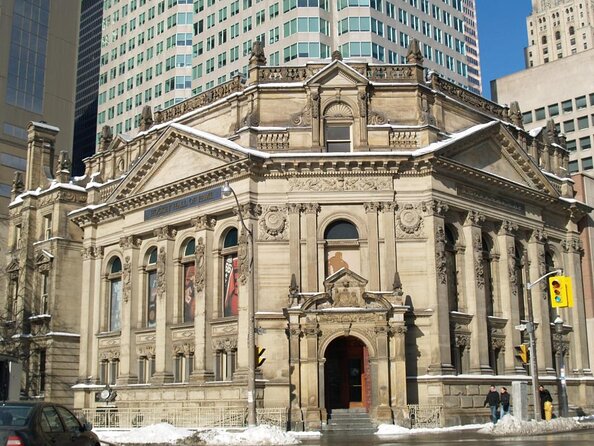
- Ten landmark stops: The route links Toronto City Hall, Old City Hall, the TD Centre, Oscar Peterson Place, the Fairmont Royal York, the Hockey Hall of Fame, the King Edward Hotel, St. James Cathedral, St. Lawrence Hall, and St. Lawrence Market.
- A private group experience: Only your group takes part, making this a good choice for families, friends, or couples who prefer not to join strangers.
- About 90 minutes: The advertised playing time is roughly one hour and 30 minutes, but you can pause whenever you wish.
- Download before heading out: The game works without Wi-Fi after the initial download, a useful detail if your mobile service is limited.
- English only: The activity is offered in English and uses the Questo app for directions, clues, and story content.
A low-cost way to see Toronto’s Old Town
At $8.44 per person, this experience is priced more like a casual city activity than a traditional guided tour. You are paying for the app access, ten challenges, directions, and written story content, not for a person walking beside you.
That distinction matters. A guide can answer questions, adjust the pace, explain a building in context, and point out details you might miss. This game cannot do that. Instead, it gives you a route and a reason to examine each stop closely. If your group enjoys puzzles, the format adds energy to a familiar sightseeing walk.
The value improves when several people play together. A group discount is available, and the private format means you can work through the clues without feeling rushed by another party. At this price, it is especially appealing for parents with older children, a few friends, or anyone who wants more structure than simply wandering downtown.
The activity has a rating of 4.9 from 15 submitted ratings, with 100 percent recommending it. That is a small sample, so I would not treat it as proof that every group will love the format. It does support the main strength of the experience: the booking process is simple, and the combination of sights, stories, and puzzles works well for people who like to set their own pace.
More Self-Guided Ghost Tours in Canada:
- Ghosts of Drumheller: a Smartphone Audio Ghost Tour
★ 4.5 · 5 reviews - Medieval Torture Museum Ticket with Audio Guide and Ghost Hunting
★ 5.0 · 962 reviews - Self-Guided Smartphone Ghost Walking Tour in Salem
★ 4.5 · 225 reviews
Start at Toronto City Hall and the famous Toronto sign
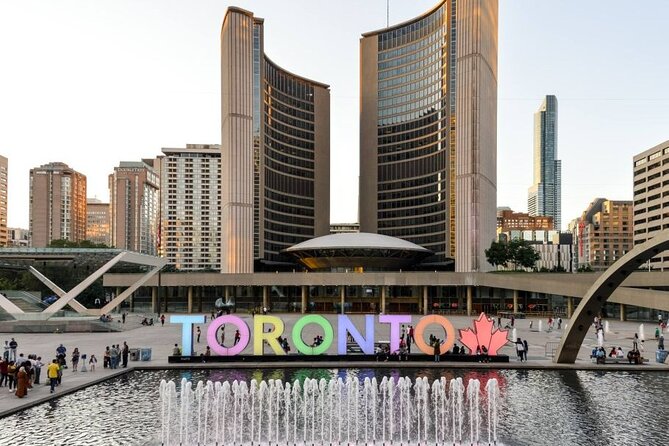
The game begins at Toronto City Hall, 100 Queen Street West. Your first challenge takes you to the well-known Toronto sign, a temporary attraction first installed for the 2015 Pan American Games.
The sign was meant to be removed in November 2016 at the earliest, but Toronto kept it after it became popular with residents and visitors. That small piece of city history fits the game’s style well. You are not just sent to a landmark for a photograph. You must look around and find the answer needed to continue.
This first stop should be easy to recognize, though the open public setting may have plenty of people moving around. Keep your phone ready, read the prompt closely, and make sure everyone in your group agrees on the answer before moving on.
The location also gives you a useful beginning point in the heart of downtown. You are close to public transportation, and the route remains in central Toronto for the rest of the game.
Old City Hall brings the civic story into focus
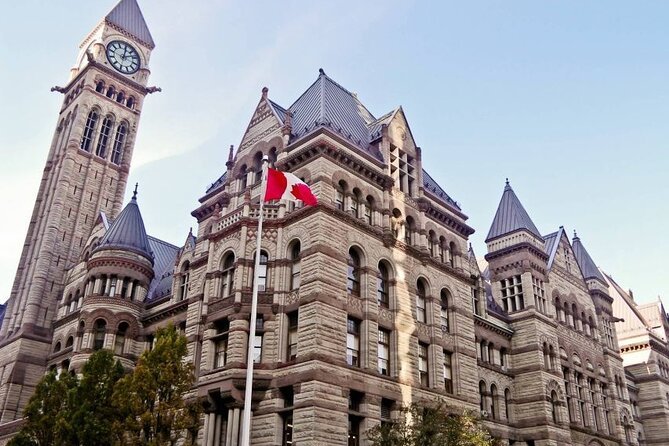
From the Toronto sign, the game takes you to Toronto’s Old City Hall. Completed in 1899, it was Toronto’s third city hall and, at the time, one of the largest buildings in the city. It was also the largest civic building in North America when completed.
Old City Hall housed Toronto’s municipal government as well as courts serving York County and Toronto. It replaced the Adelaide Street Court House, giving you a sense of how quickly the growing city needed larger public buildings.
This is one of the stronger stops for people who like architecture and urban history. The building is not simply a backdrop for a puzzle. Its original purpose tells you about Toronto’s rapid growth and the expanding role of city government.
The challenge asks you to inspect the area for an answer. That approach can make a large building feel more approachable, since you are searching for specific details rather than trying to take in every stone and window at once. The limitation is that the app cannot respond to follow-up questions, so anyone wanting a detailed architectural explanation may want to do extra reading later.
The TD Centre shifts the mood from old Toronto to modern commerce
Next comes the Toronto-Dominion Centre in the Financial District. The complex is the global headquarters of the Toronto-Dominion Bank and includes six towers plus a pavilion. Bronze-tinted glass and black painted steel give the site a distinctly modern appearance.
About 21,000 people work in the complex, making it Canada’s largest commercial office complex. That figure helps explain why this stop feels different from Old City Hall or the churches and markets later in the route. The game places Toronto’s older civic story beside the city’s modern business center.
You will again search the surroundings for a clue. This is where the self-guided format works best for a group that likes to notice design details, signs, and public features. You can take a few minutes to look carefully, rather than simply hearing a guide point out the building and moving on.
Because this is an active office district, the surroundings may feel more functional than scenic. The attraction here is the contrast between the architecture and the story of Toronto’s commercial growth, not a quiet historic setting.
More Dark History Tours in Canada:
- Toronto: Dark History Nighttime Walking Tour
★ 4.7 · 273 reviews - Adults-Only New Orleans Ghost, Crime, Voodoo, and Vampire Tour
★ 5.0 · 6,545 reviews - Edinburgh: Dark Secrets of the Old Town Ghost Walking Tour
★ 4.6 · 1,671 reviews - New Orleans Adults-Only True Crime and Ghost Walking Tour
★ 5.0 · 1,666 reviews
Oscar Peterson Place adds public art and open space
Between the TD Centre towers are two large areas known together as Oscar Peterson Place. The northern section has a more formal granite design, while the southern area includes a lawn and The Pasture, a sculpture by Saskatchewan artist Joe Fafard.
This stop gives the route a pause from enclosed streets and tall buildings. It also adds public art to a game otherwise built around major civic, religious, hotel, and market landmarks. The sculpture and open space make this a good place to slow down for a moment if your group needs a break.
The clue still requires you to pay attention to what is around you. You are not being handed a simple list of facts. You must connect the prompt to something visible at the location, then enter the answer to move ahead.
The public setting can be a mixed blessing. It is easy to stop and regroup, but you may need patience if the area is busy or if your group wants time to examine the art without getting in the way of office workers.
The Fairmont Royal York shows Toronto’s grand hotel tradition
The Fairmont Royal York is the route’s major hotel stop. For nearly 90 years, it has hosted royal guests, heads of state, celebrities, sports stars, and millions of other visitors. Its long role in Toronto’s luxury hotel scene gives the game a chance to shift from government and commerce to hospitality and status.
You can expect another location-based challenge here, with the app asking you to inspect the area for the information needed to continue. The Royal York is a useful reminder that downtown Toronto’s history is not only about public institutions. Hotels helped shape how the city received powerful people, business visitors, and international attention.
This stop may appeal to you if you enjoy grand city hotels but are not booking a room there. You can appreciate the building as part of Toronto’s story without paying for a luxury stay.
The route does not promise an interior hotel tour, so keep your expectations in check. This is a short puzzle stop connected to the hotel’s history, not a behind-the-scenes visit.
The Hockey Hall of Fame connects the walk to Canadian sports culture
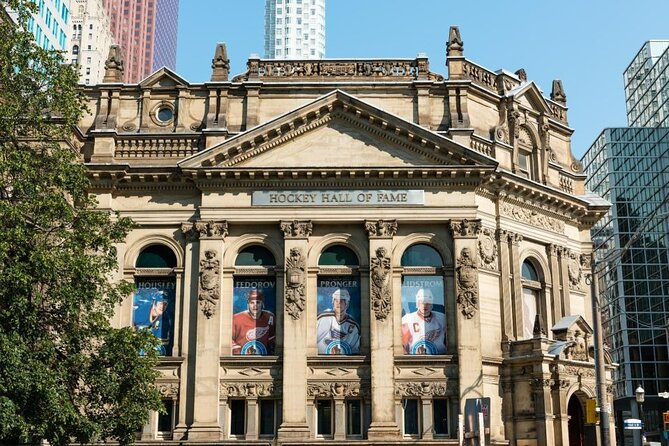
The next location is the Hockey Hall of Fame, now inside Brookfield Place in a historic Bank of Montreal building. Its first permanent building opened at Exhibition Place in 1961. The hall moved to its current downtown location in 1993 and has hosted International Ice Hockey Federation exhibits and the IIHF Hall of Fame since 1998.
This is one of the route’s most recognizable stops, particularly if hockey is part of your group’s interests. The location also adds a strong Canadian cultural note to a walk that has so far focused on civic buildings, banks, offices, and hotels.
The puzzle gives you a reason to examine the exterior surroundings and connect the place to its institutional history. If you want to visit the Hockey Hall of Fame itself, remember that the game only guides you to the landmark. Admission to the hall is not included in the stated price.
That can be either a benefit or a drawback. You get a taste of the site without committing to a longer museum visit, but hockey fans may find themselves wanting more time than the 90-minute route allows.
The King Edward Hotel recalls Toronto’s early luxury ambitions
The King Edward Hotel was designed by Chicago architect Henry Ives Cobb and Toronto architect E. J. Lennox for developer George Gooderham’s Toronto Hotel Company. It received its name from King Edward VII and opened in 1903 with 400 rooms and 300 baths.
The hotel also claimed to be entirely fireproof, a detail that gives the stop a practical historical angle. This was not only a place built to impress. It reflected the technology, scale, and confidence of a growing city trying to provide modern luxury.
The challenge here works as a close-looking exercise. You will need to inspect the area, find the answer, and then follow the app’s directions. The stop pairs naturally with the Fairmont Royal York, but the two hotels tell different parts of Toronto’s hospitality story.
If your group is interested in architecture, hotel history, or the ambitions of early twentieth-century Toronto, this is one of the more rewarding stops. If you prefer museums with extensive displays, the brief outdoor encounter may feel thin.
St. James Cathedral marks the oldest congregation in the city
The Cathedral Church of St. James is an Anglican cathedral in downtown Toronto and the home of the city’s oldest congregation. The parish was established in 1797.
That date gives the church a special place in the route. By this point, you have seen modern towers and major hotels. St. James takes you back to the early roots of the city and its religious community.
The game asks you to find another answer around the site. You should treat this as a respectful public stop. If you hope to enter, keep in mind that the supplied tour information does not promise interior access or a guided church visit.
For me, this is the kind of location that makes the route more than a downtown scavenger hunt. The app connects individual places to the growth of Toronto, from its early congregation to its later commercial and civic centers.
St. Lawrence Hall and the birth of public city life
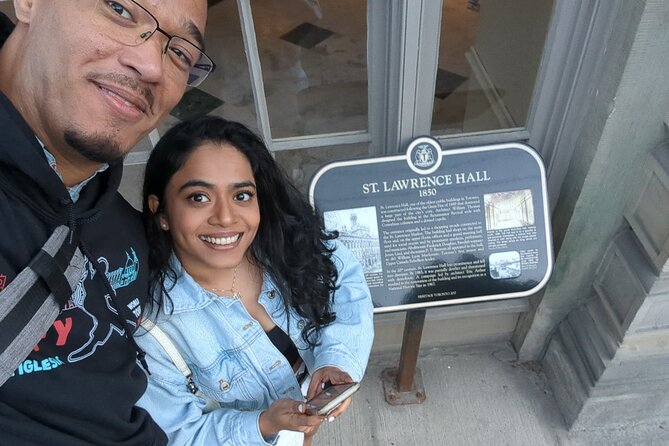
St. Lawrence Hall opened in 1850 as Toronto’s first large meeting hall. Named for Canada’s patron saint, it served for years as a center of cultural and political life.
Balls, receptions, concerts, exhibitions, and lectures took place here. That list gives you a useful picture of nineteenth-century public life. Before Toronto had today’s range of arenas, theaters, and event spaces, a major hall like this was where people gathered for both entertainment and civic discussion.
The puzzle encourages you to look at the building and its surroundings instead of treating the stop as a quick photograph. It is a compact way to learn why this hall mattered to the city.
This is also a good point to check your time. The full game takes about 90 minutes, but your actual pace depends on how long you spend at each stop and how quickly your group solves the clues.
Finish at St. Lawrence Market
The game ends at the St. Lawrence Market South building, on the southwest corner of Front and Lower Jarvis Streets. Along with the St. Lawrence Market North building and St. Lawrence Hall, it forms the St. Lawrence Market complex.
Ending here makes practical sense. You finish in a major public market area rather than at an isolated monument, so you can continue with food, shopping, or more sightseeing after the game. The final challenge asks you to find the answer at the location, completing the route from City Hall to the market.
The endpoint also gives the walk a satisfying change of character. You begin with a public square and civic buildings, pass through financial and hotel districts, and finish in one of Toronto’s established market areas.
The app guides you step by step, so follow each instruction closely. If you skip ahead or enter an incorrect answer, you may lose the route’s rhythm.
Timing, phones, and group size
The activity is available every day from midnight to 11:30 p.m. That does not mean every stop will feel equally pleasant at every hour. The wide schedule gives you freedom, but daylight and normal public activity may be more practical for finding visual clues.
Download the game before you start. After that initial download, no Wi-Fi is needed. You receive a mobile access code, and the Questo app supplies the directions, challenges, and story content.
The experience is private, and only your group participates. Most people can take part, service animals are allowed, and the route is near public transportation. No physical guide accompanies you, so one person should take responsibility for reading the instructions and keeping the group together.
Free cancellation is available up to 24 hours before the start time. Cancel inside that 24-hour window and you will not receive a refund, and changes during that period are not accepted.
Who should book this Toronto history game?
I would choose this for a group that wants a light, social way to see central Toronto. It suits families with older children, friends who enjoy puzzles, couples who dislike fixed group tours, and repeat visitors looking for a fresh reason to walk between familiar landmarks.
It is less suitable if you want a historian beside you, a long architectural lecture, or guaranteed indoor entry at the buildings along the way. The written stories and clues provide a framework, but the experience depends on your group’s curiosity and willingness to stop, look, and solve.
At $8.44, the risk is low. You get ten challenges, a clear route, Old Town history, and the ability to pause. Just remember that the price does not include admission to attractions, food, or a physical guide.
Should you book it?
Book this game if you want to explore downtown Toronto at your own speed and enjoy working out clues together. The route covers a wide mix of places, from the Toronto sign and Old City Hall to the Hockey Hall of Fame, St. James Cathedral, and St. Lawrence Market.
Skip it if you prefer a live guide or want detailed answers on the spot. For everyone else, the low price, private format, flexible schedule, and strong range of landmarks make this a practical introduction to Toronto’s Old Town, with just enough game play to keep your walk focused.
FAQ
How long does the Toronto Old Town dark history game take?
The activity takes approximately one hour and 30 minutes.
Where does the experience start?
It starts at Toronto City Hall, located at 100 Queen Street West, Toronto, Ontario M5H 2N2.
Where does the game finish?
It finishes at St. Lawrence Market in Toronto, Ontario M5E 1C3.
How many puzzle challenges are included?
The experience includes 10 puzzle challenges.
Is a physical tour guide included?
No. The experience is self-guided through the Questo app and does not include a physical guide.
Do I need Wi-Fi during the game?
Wi-Fi is not needed after the initial download.
What language is the activity offered in?
The activity is offered in English.
Can I pause and resume the game?
Yes. You can pause and resume at any time.
Is this a private group activity?
Yes. Only your group participates.
What is the cancellation policy?
You can cancel for a full refund up to 24 hours before the experience start time. Cancellations or changes made less than 24 hours before the start time are not accepted for a refund.
Ghost walks heavy on history around Canada
- Banff: Paranormal History Walking Ghost Tour
★ 4.7 · 46 reviews - Haunted Walk at Beechwood Cemetery National Historic Site
★ 4.5 · 6 reviews - Savannah History and Haunts Candlelit Ghost Walking Tour
★ 5.0 · 3,235 reviews - Stockholm: Ghost Walk and Historical Tour
★ 4.7 · 2,685 reviews
Freshly reviewed haunts around Canada
- Colonial Old Montreal Paranormal Investigation★ 4.5 · 2 reviews
- Haunted Griffintown Ghost Walking Tour in Montréal★ 5.0 · 47 reviews
- Haunted Mountain★ 4.5 · 34 reviews
- Haunted Downtown★ 5.0 · 54 reviews
- Orignal Haunted Walk of Kingston 75-Minute Ghost Tour★ 4.5 · 113 reviews
- Ghost Tour of Queen’s University★ 4.5 · 6 reviews
- Canmore Ghost Walks★ 5.0 · 17 reviews
- Dinosaurs, Canyons & Ghost Towns: Ultimate Drumheller Day Tour★ 4.5 · 10 reviews
Toronto Ghost Tours, compared.
Browse the lists this tour appears in