
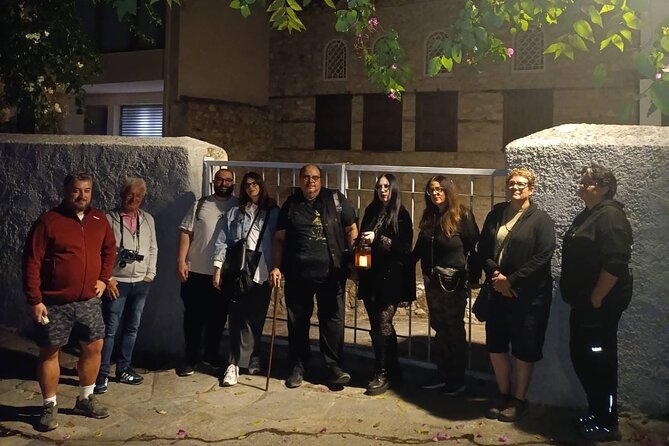
Review · GREECE
Athens Ghost Tour
Athens has an unusual setting for a ghost walk: 2,500 years of war, faith, politics, and death packed into a short evening route. You move from the oldest ghost story linked to Stoic philosopher Athenodoros to Socrates’ final prison, with the Acropolis often rising above the darkened streets.
I like the way this tour reaches places you might skip on a normal sightseeing walk, including the Benizelou Mansion, an old Ottoman school and prison, and the neighborhood around Socrates’ home. I also like the mix of ancient, Byzantine, Ottoman, and modern Greek stories, plus the chance to use a Gauss meter and camera while walking.
The main caution is simple: this is more historical than frightening. Some equipment may not register anything, and the route includes uphill walking, steep steps, and uneven ground. At $43.62 per person, you should book it for the stories and nighttime Athens first, ghostly activity second.
What makes this Athens night walk different
- Athenodoros and the oldest ghost story: Begin with a tale linked to the Stoic philosopher who tutored Augustus, Rome’s first emperor.
- Socrates’ prison and final words: Visit the place associated with his death and his thoughts about the soul and the afterlife.
- Ten historic stops in two hours: The route connects ancient ruins, churches, Ottoman sites, and modern Greek history.
- A small-group format: The maximum group size is 15 people, which gives the guide room to answer questions.
- Ghost-hunting tools: You may use a Gauss meter and camera to look for unusual signals, though activity is not guaranteed.
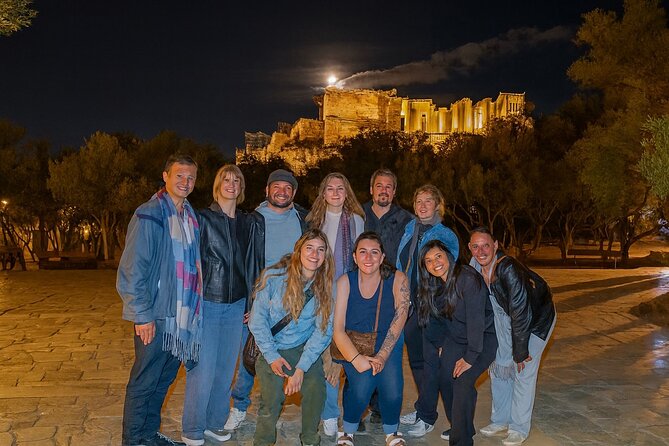
- Athens after dark: You get nighttime views of the Acropolis and Hephaestus’ Temple while walking through quieter historic quarters.
Begin at Thision with Athens’ oldest ghost story
The meeting point is Thision Open Air Cinema on Apostolou Pavlou, with the walk beginning at 8:00 pm and ending back at the same place. This is a useful starting point because the evening route quickly enters the old center, where ancient ruins and later neighborhoods sit close together.
The first stop is the area of Stenopos Kollytos. Here the guide introduces the story of Athenodoros, a Stoic philosopher who later became the personal tutor of Augustus. The tale is presented as one of the oldest ghost stories in the world, and it gives the tour a strong historical starting point.
I like this opening because it treats ghosts as part of the way people have explained death and the unknown across many centuries. You are not simply hearing a modern campfire story. You are hearing how an ancient account helped shape later ideas about the afterlife.
You spend about 10 minutes here. That short stop also gives you an early sense of the tour’s rhythm: walk, listen, consider the site, and then move on before the story loses its force.
Other ghost walks and hunts we rate around the world
- New Orleans Premier Ghost, Voodoo and Vampire Walking Tour
★ 4.5 · 12,856 reviews - The World Famous Underground Ghost Tour
★ 4.5 · 9,272 reviews - Chicago: Gangsters and Ghosts Walking Tour
★ 5.0 · 7,155 reviews
The Acropolis and its former Turkish cemetery
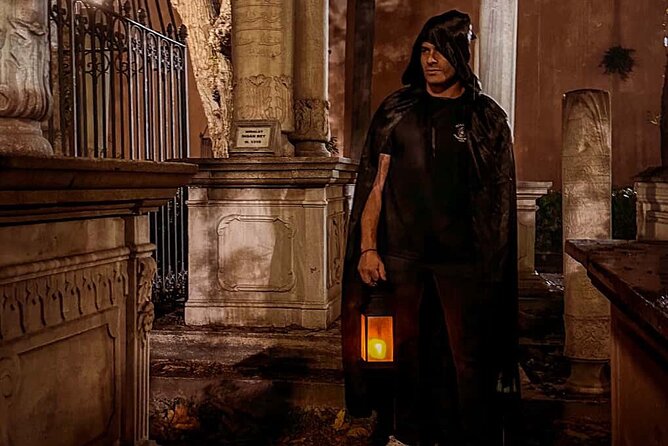
The second stop is near the front gate of the Acropolis. The tour explains that this area once included a Turkish graveyard during the four centuries of Ottoman rule. The focus is not on entering the Acropolis itself, but on considering what happened around one of the world’s best-known ancient monuments after classical Athens had passed.
This is an important shift in viewpoint. Many visitors see the Acropolis as a single ancient Greek monument, yet the hill and its approaches were used and altered by later communities. A burial ground near the entrance adds a human and uneasy layer to the familiar postcard view.
You spend about 15 minutes here. The stop includes admission according to the tour details, but you should not assume this means entry into every Acropolis monument. The route is built around outdoor locations and the stories attached to them.
Areopagus, murder trials, and a Christian sermon
At the Areopagus, you stand on a sacred rock tied to ancient Greek murder trials. The guide also connects the site with a sermon given to the Council of the Areopagus by a Christian saint.
This stop works well because it brings together law, religion, and public speaking. The rock was not only a scenic perch beside the Acropolis. It also carried serious civic and spiritual meaning.
The stop lasts about 15 minutes. The surface can be uneven, and the wider walk includes slopes and steps, so I would wear shoes with a firm sole. The route is not described as suitable for people with limited mobility, and the supplied details call for moderate physical fitness.
Stratonos and a young wartime hero
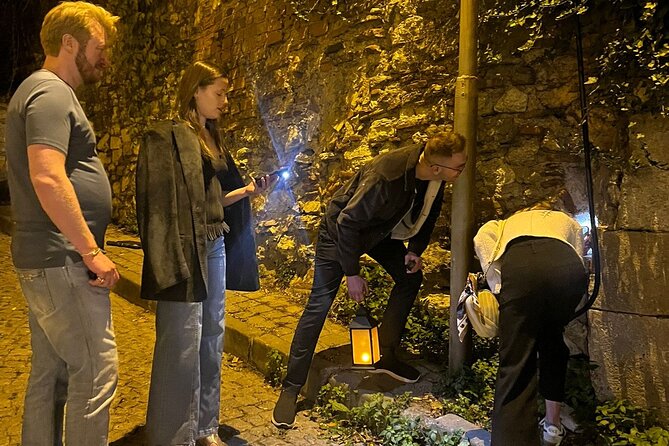
At Stratonos, the story turns to the 20th century. The guide tells of young Konstantinos, who fell while protecting the Greek flag during the Nazi invasion. The group then tries to communicate with him.
This is one of the tour’s more personal stories. The earlier stops deal with philosophers, trials, and rulers. Here, the focus is a young soldier and a moment of sacrifice during a modern invasion.
You spend about 10 minutes at the site. The emotional weight depends heavily on the guide’s storytelling, so the English presentation matters. The tour is offered in English, and one account describes an American guide assisted by a Greek-speaking friend who translated questions. No guide names are provided, so you should expect the staff arrangement to vary.
Same old streets, another story to hear:
- Edinburgh: Haunted Underground Vaults and Graveyard Tour
★ 4.6 · 6,607 reviews - Adults-Only New Orleans Ghost, Crime, Voodoo, and Vampire Tour
★ 5.0 · 6,545 reviews - Prague: Ghost Walking Tour Where Legends Come To Life
★ 4.4 · 5,253 reviews - Prague: Ghosts, Legends, Medieval Underground & Dungeon Tour
★ 4.3 · 5,104 reviews
Saint Nicholas Rangavas and the courtyard monk
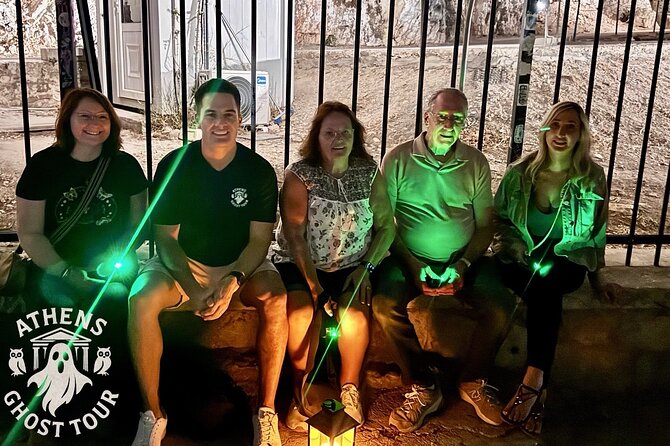
The walk continues to Prytaneiou and the Church of Saint Nicholas Rangavas, described as the oldest church in Athens. Its story reaches back to a relative of a Byzantine emperor who helped build it.
The darker tale concerns a cannonball that destroyed part of the church and killed a monk who was hiding in the courtyard. This story gives the stop a different tone from the ancient sites. It is not only about a spirit appearing in a ruined place. It is about how violence can become attached to a building’s walls and grounds.
The visit lasts about 10 minutes and does not require a separate admission fee. Since the church is a working religious site, the experience is best approached with quiet attention rather than theatrical expectations.
Benizelou Mansion and the old olive press
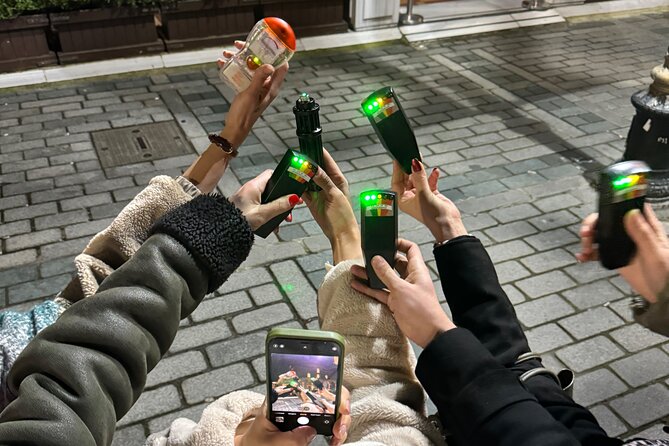
The Benizelou Mansion is described as Athens’ oldest house and was once home to Saint Philothea. The tour takes you to the back of the property, where a 500-year-old olive press is said to have been used as a torture device for rebellious slaves owned by the Benizelou family.
This may be the most unusual stop on the route. The mansion connects domestic life, Byzantine-era faith, and the treatment of enslaved people in one compact location. It also shows why a ghost walk can reveal parts of Athens that a standard list of major monuments may pass over.
You spend about 15 minutes here. If the building is not open for regular visits at another time, this outside look may be especially useful for getting your bearings. The tour details do not promise interior access, so plan on hearing the story from the surrounding area.
The Ottoman Madrassa and the hangman’s tree
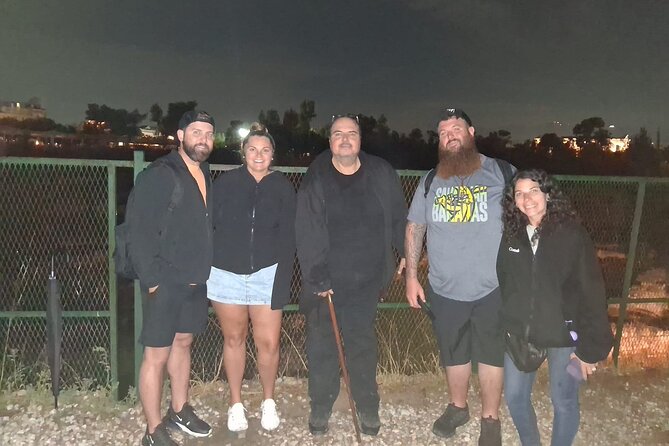
Beside the Roman Agora, the route reaches the Ottoman Madrassa. It began as a religious school for Ottoman citizens, then became a prison after the Greek War of Independence.
The courtyard contains the story of a special tree used for hangings. The tour says hundreds of Greeks and Turks were killed there. This is a grim stop, but it helps explain how the same place can change purpose as political power changes hands.
The stop lasts about 10 minutes and is listed as free. The Roman Agora nearby adds useful context, but the walk does not promise a full archaeological visit. You are coming for the location and its stories, not an extended museum-style explanation of every visible stone.
The Ancient Agora and the Tyrannicides
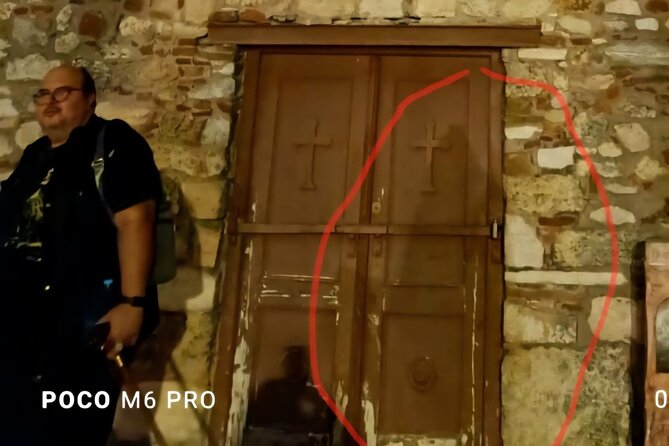
At the Ancient Agora, you reach the former center of civic life. Temples, homes, theaters, schools, and festivals once filled this part of Athens. The old route of the Panathenaic Festival also passed through the area.
The tour highlights the Tyrannicides, two murderous lovers who tried to end the rule of the Athenian tyrants. That story brings political violence into a place usually presented as the birthplace of public debate and democracy.
I like this stop because it gives the ruins a human edge. The Agora was not only a collection of columns and foundations. It was a place of ambition, public ceremony, private rivalries, and dangerous political action.
You spend about 10 minutes here. The stop is listed with admission included, but the tour still moves at a brisk pace. If you want a full visit to the Ancient Agora Museum and archaeological grounds, set aside separate daytime hours.
Socrates’ prison and the question of the afterlife
The prison of Socrates is one of the evening’s strongest stops. Here, the philosopher was held before drinking hemlock and dying. The guide focuses on his final speech to friends and followers, especially his thoughts about the soul and what comes after death.
This is where the tour’s subject and its historical material fit together most naturally. You are not just looking for unexplained sounds or signals. You are standing at a place linked to a man who faced death by reasoning about the soul.
The stop takes about 10 minutes and is listed with admission included. The walk also helps correct a common point of confusion: the place shown on some maps may not be the official location associated with his detention. The guide uses the older prison site as part of the route.
Metamorphosis Church and a hurried burial
The final stop is the Church of Metamorphosis, a 12th-century church whose stones are tied to stories of crime and death. The route also covers the rushed burial of a hero of the Greek War of Independence who was murdered after being thrown from the Acropolis.
This ending brings the walk back to a small religious building rather than a major ruin. It reinforces the tour’s broader point: Athens’ unsettling stories are often found in ordinary lanes, church walls, courtyards, and overlooked corners.
You spend about 10 minutes here before returning to the meeting point. The full route is advertised at approximately two hours, though the exact pace can depend on questions, group size, and walking conditions.
What the ghost-hunting equipment can and cannot do
The tour uses equipment such as a Gauss meter and camera to look for unusual signals. That can make the walk more hands-on, especially if you enjoy testing a place rather than only listening to a guide.
You should keep your expectations measured. There may be little or no detectable activity, and one account specifically notes that the equipment did not work particularly well. The tools are best treated as an extra layer of entertainment, not proof that a spirit is present.
The guide remains the key part of the experience. Several comments praise the guides for being friendly, patient, and able to answer questions with added historical context. One account says the guide slowed the pace for older family members, though the route still includes steep sections and difficult steps.
Is $43.62 a fair price?
At $43.62 per person, this is not the cheapest way to take an evening walk in Athens. You are paying for a small-group experience, an English-speaking guide, a planned route through ten historic locations, and the use of ghost-hunting tools.
The value depends on what you want. If you mainly want dramatic paranormal encounters, the price may feel high because the equipment might produce no results. If you want an unusual history walk with a supernatural frame, the price is easier to justify.
I would compare it with the cost of a standard guided city walk, then ask how much you value the after-dark setting and the less familiar stops. The route covers a lot of ground and reaches places such as the oldest house in Athens and Socrates’ prison, which can make the evening feel more substantial than a simple storytelling session.
The tour is booked an average of 48 days ahead, so popular dates may fill early. Free cancellation is available if you cancel at least 24 hours before the 8:00 pm start. Changes or cancellations inside that window are not accepted for a refund.
Who should book this Athens ghost tour?
I would choose this tour if you like history with a darker edge, want to see Athens after sunset, and enjoy walking between several locations rather than staying in one haunted building. It suits curious adults, older children who can manage the walking, and anyone who wants context for places outside the standard Acropolis visit.
I would think twice if you need step-free access, dislike uneven streets, or want a theatrical horror show. The group may hear many serious historical stories, but the supernatural evidence may be limited.
Service animals are allowed, and the tour is near public transportation. The maximum group size is 15, which is small enough for questions without promising a private tour.
Final decision: book for history, not guaranteed hauntings
Book the Athens Ghost Tour if your ideal evening combines ancient ruins, old churches, Ottoman sites, wartime memory, and questions about the afterlife. The best moments are likely to come from the stories of Athenodoros, Socrates, Saint Philothea, Konstantinos, and the people tied to these sites.
Skip it if you want constant scares or reliable activity from the equipment. This is a historical walking tour with ghost-hunting touches, and that distinction matters. For the right audience, the reward is a thoughtful, unusual look at Athens after dark, with fine views and a route you would be unlikely to create on your own.
FAQ
Where does the Athens Ghost Tour begin?
The tour begins at Thision Open Air Cinema, Apostolou Pavlou 7, Athens 118 51, Greece.
What time does the tour start?
The start time is 8:00 pm.
Where does the tour end?
The activity ends back at the original meeting point.
How long does the tour last?
The tour lasts approximately two hours.
What language is the tour offered in?
The tour is offered in English.
How large is the group?
The maximum group size is 15 people.
How physically demanding is the route?
A moderate level of physical fitness is recommended. The route includes uphill walking and steep steps, and it may be difficult for people who are elderly or disabled.
Can I cancel for a refund?
Yes. You can cancel at least 24 hours before the start time for a full refund. Cancellations or changes made less than 24 hours before the start time are not accepted for a refund.
Freshly reviewed haunts around the world
- New Orleans French Quarter Dark History, Haunts, and Laughs Tour★ 5.0 · 30 reviews
- New Orleans’ Finest Haunted Pub Tour★ 4.5 · 38 reviews
- Cheers New Orleans! Cocktails, History, Voodoo & Paranormal Tour★ 4.0 · 4 reviews
- Haunted Drunken History Tour from New Orleans★ 5.0 · 135 reviews
- The Original Asbury Park Ghost Tour★ 4.5 · 29 reviews
- Destrehan Plantation Haunted Night Tour★ 4.5 · 100 reviews
- New Haven’s Ghost Walk★ 3.5 · 69 reviews
- Ghosts of Tonopah Haunted History GPS/APP Smartphone guided Walking Tour outside★ 4.5 · 7 reviews
Greece Ghost Tours, compared.
Crete: Quad Safari, Olive Mill with Tasting & Ghost Village
Read our review →
Agia Pelagia: Sunset or Morning Quad Tour & Ghost Town Visit
Read our review →
Corfu Ghost Stories, Dark Legends & Facts Night Tour
Read our review →
Kalamata: Paranormal Walking Tour in the historical center
Read our review →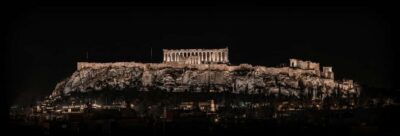
Athens Ghost Walk: Mystical Ruins & Ancient Legends
Read our review →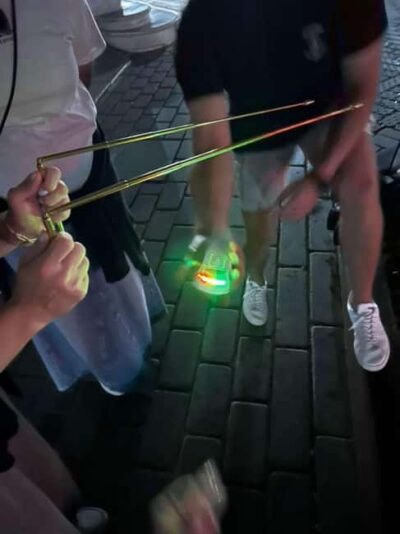
Browse the lists this tour appears in