
Review · LIMASSOL DISTRICT, CYPRUS
From Limassol: Famagusta with Salamis and Varosha Ghost Town
Northern Cyprus gives this day trip its real pull. In eight hours, you move from the grand remains of ancient Salamis to Famagusta’s medieval walls and then to Varosha, a shuttered resort frozen by the events of 1974. It is an unusually strong mix of archaeology and modern political history.
I like the range of places covered for $93, especially the guided Salamis visit and the chance to see Famagusta without arranging border transport yourself. I also like the free time in the old town, since you can choose lunch or a little shopping instead of being marched from one stop to the next. The main drawback is pace: you cover a lot of ground, and some stops may feel brief.
Key points to know
- Salamis is the day’s major archaeological stop, with entrance included and free time to look around.
- Famagusta combines Saint Nicholas Cathedral and Othello Tower with time for lunch and shopping.
- Varosha is viewed from Constantia Beach, not entered, giving you a distant view of the fenced-off resort.
- Guide Lisa has received especially strong praise for her warmth, English, and detailed explanations, though one account found the guide’s presentation too personal and subjective.
- The border crossing requires your passport or EU ID, so check your documents before leaving Limassol.
- The meeting point is outside St Raphael Resort at 9:30 a.m., and you must arrange your own way there.
Why this Limassol day trip is worth your time
Many Cyprus excursions stay on one side of the island. This one crosses the UN-patrolled border into northern Cyprus, allowing you to compare several periods of the island’s past in a single day.
At Salamis, you see the scale of an ancient city that once served as Cyprus’s capital for more than a thousand years. In Famagusta, the focus shifts to medieval religious and military buildings. At Varosha, history becomes immediate and unsettling: an abandoned holiday district remains behind fences after the upheaval of 1974.
That contrast gives the outing more weight than a standard sightseeing loop. You are not simply checking off ruins. You are seeing how Cyprus changed over time, and how old political divisions still shape what you can visit.
The English-speaking guide is important here. Salamis can be a lot of broken stone without context, while Famagusta and Varosha need careful explanation. Lisa is the guide named most often in the available feedback, and her strengths appear to be warmth, strong subject knowledge, and a willingness to answer questions. At least one account found her English tiring to follow, so your enjoyment may depend partly on how comfortable you are with spoken English.
Other ghost walks and hunts we rate around the world
- New Orleans Premier Ghost, Voodoo and Vampire Walking Tour
★ 4.5 · 12,856 reviews - The World Famous Underground Ghost Tour
★ 4.5 · 9,272 reviews - Chicago: Gangsters and Ghosts Walking Tour
★ 5.0 · 7,155 reviews
Meeting the coach at St Raphael Resort
The day begins at 9:30 a.m. outside the entrance to the St Raphael Resort reception area. This is not a standard hotel-room pickup, so you need to arrange your own transportation to the meeting point.
That detail matters if you are staying in central Limassol or elsewhere in the district. Allow enough time to reach the resort without cutting it close. The supplied GPS link points to St Raphael Resort, and the meeting location is just outside the reception entrance.
The coach is fully air-conditioned, which is welcome on a long day. The tour lasts about eight hours, and the drive between Limassol, Salamis, Famagusta, and the coast means you will spend a fair amount of time seated. A calm driver can make a big difference. Kostas has been praised for smooth, professional driving, a useful quality on a route with several stops and a border crossing.
The description says hotel transfers are included, but the practical meeting instructions specify that you must get yourself to St Raphael Resort. I would treat the resort as the firm starting point unless the operator gives you different instructions before departure.
Crossing into northern Cyprus
Bring your passport or EU ID. This is not an optional extra, since the route crosses a controlled border. Keep the document handy rather than packed at the bottom of your day bag.
Border procedures and driving times can affect the schedule. The tour notes that all times are approximate and that routes may change with weather. That means you should not plan a tight dinner reservation or another paid activity immediately after the coach returns.
The crossing also adds context to the day. You are not just going to another set of monuments. You are moving through a divided island, and the guide’s explanation can help you understand why some places are open, some are fenced, and some remain difficult to visit.
The subject needs care. One account found the guide’s discussion too strongly shaped by personal memories and the Greek Cypriot viewpoint, with too little neutral explanation. That is worth keeping in mind. The story of Cyprus is painful and contested, and you may hear a personal interpretation rather than a fully balanced political briefing.
Salamis, where the ancient city sets the tone
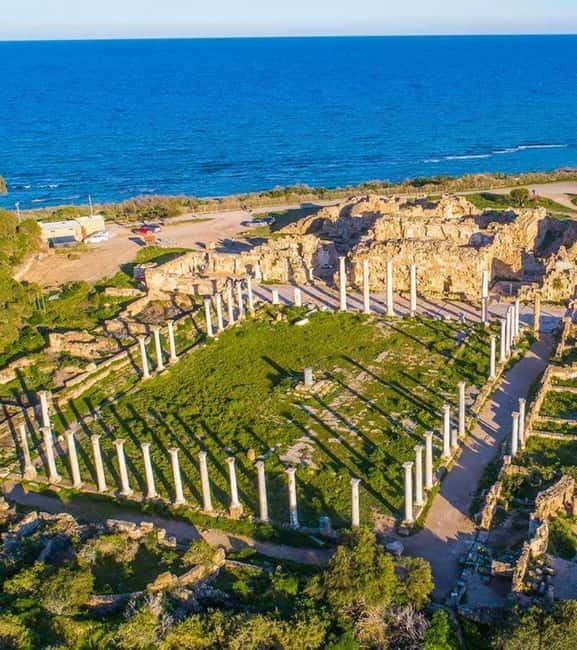
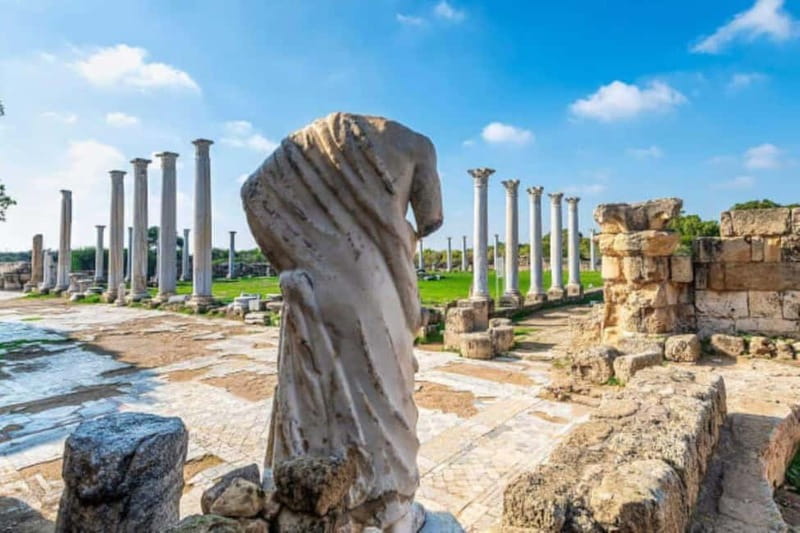
Salamis is the first major stop and likely the highlight for anyone who enjoys archaeology. The site lies on Cyprus’s east coast, with views toward the Mediterranean, and it once served as the capital of Cyprus for more than a thousand years.
Your guide leads you through the ruins, then you have time to look around independently. That combination works well. A guide can explain the city’s role and point out what matters, while free time lets you set your own pace and take photographs.
The attraction is scale. Salamis was not a small isolated monument. It was a major Greek kingdom and an important center in the wider Mediterranean world. Even without knowing every period of its past, you can grasp the size and ambition of the settlement from the remains.
Wear shoes with a firm sole. The tour specifically recommends comfortable footwear, and archaeological sites can involve uneven surfaces and exposed ground. This stop is not a good fit for anyone with mobility limitations, and the activity is also listed as unsuitable for pregnant women.
Do not expect a fully reconstructed ancient city. The value comes from reading the surviving remains with help from the guide. If you like quiet time with ruins, you will appreciate the free period. If you prefer a tightly scripted tour with every minute filled, you may find the independent portion less structured.
Same old streets, another story to hear:
- Edinburgh: Haunted Underground Vaults and Graveyard Tour
★ 4.6 · 6,607 reviews - Adults-Only New Orleans Ghost, Crime, Voodoo, and Vampire Tour
★ 5.0 · 6,545 reviews - Prague: Ghost Walking Tour Where Legends Come To Life
★ 4.4 · 5,253 reviews - Prague: Ghosts, Legends, Medieval Underground & Dungeon Tour
★ 4.3 · 5,104 reviews
Famagusta’s cathedral and Othello Tower
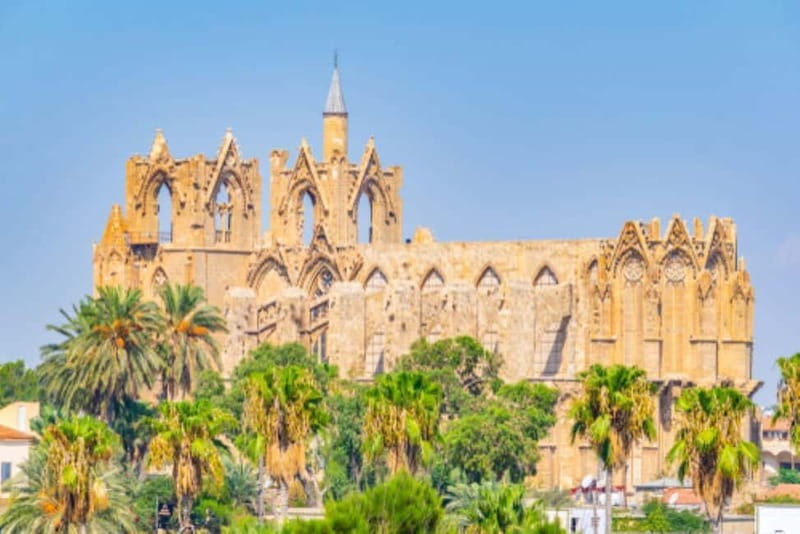
The route continues to Famagusta, where the city’s old quarter brings a different kind of history. The planned visits include Saint Nicholas Cathedral and Othello Tower, two landmarks that help explain the city’s medieval importance.
Saint Nicholas Cathedral is a striking reminder of the period when Famagusta was linked to Latin Christian rule. Its cathedral form gives the old town a strong European medieval character, quite different from the classical remains at Salamis.
Othello Tower adds the defensive side of the city. The name has literary associations, but the practical interest is the tower itself and its place within Famagusta’s fortifications. Together, the cathedral and tower show you a city shaped by religion, trade, and military power.
You should expect a guided visit rather than a long, detailed architectural study. The day covers several locations, so the guide has to keep moving. Still, these two stops are well chosen because they offer a clear sense of Famagusta without requiring a full day inside the old town.
Free time for lunch, shopping, and a closer look at Famagusta
After the main sights, you receive free time in Famagusta. You can use it for lunch, a coffee, shopping, or a walk through the old town.
Food and drinks are not included, and coffee breaks are also excluded, so budget for this part. The tour advises carrying cash for food and souvenirs. Since the schedule is shared, keep an eye on the meeting time and do not wander so far that you need to hurry back.
This free period is one of the better features of the day. Guided sightseeing can become tiring when every stop has a fixed explanation. A pause lets you sit down, get your bearings, and decide how much more old-town walking you want to do.
The tradeoff is that you do not control the length of the break. One assessment of the outing found that it tries to fit many attractions into one day, leaving less time than some people might want at each location. That is fair. You are getting breadth, not a slow study of Famagusta.
Seeing Varosha from Constantia Beach
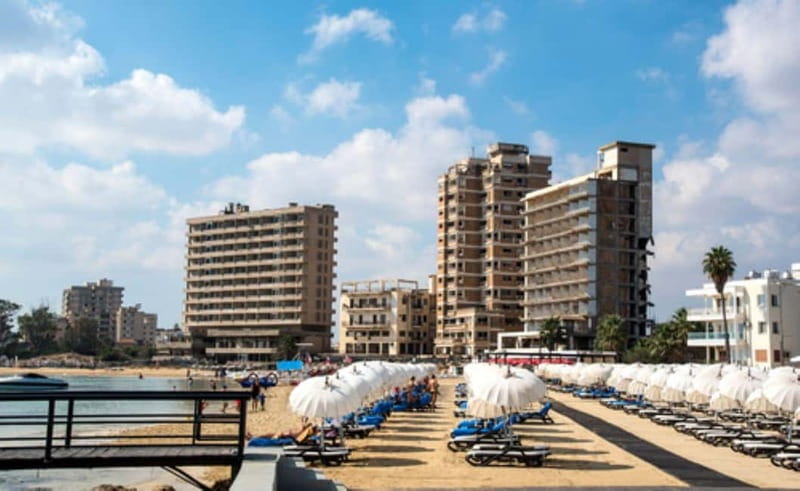
The final major stop is Constantia Beach, where you look across toward the ghost town of Famagusta, also known as Varosha. The abandoned resort was left behind during the Turkish invasion of 1974 and remains enclosed by fencing and restricted access.
This is a brief stop, but it can be the most emotionally powerful. From the beach, you see a once-famous holiday district that has remained frozen rather than redeveloped. The contrast between a seaside setting and an empty resort gives the visit its force.
Be clear about what you are buying. You view Varosha from outside the enclosed area. This is not an interior walking tour, and you should not expect to enter the abandoned hotels or streets.
The stop also brings the day’s political story into focus. Salamis shows a distant ancient past. Varosha shows a wound that still affects the island today. The guide’s role is especially important here, since personal testimony and political interpretation can shape how you understand what you see.
I would approach this part with patience and respect. It is not a light photo stop, even though the coast can look inviting. The point is the uneasy contrast between the beach, the fenced resort, and the human story behind it.
How the $93 price measures up
At $93 per person, the tour offers solid value if you want several northern Cyprus highlights without hiring a private driver or organizing the border crossing yourself.
The price includes the air-conditioned coach, a full-day guided excursion, entrance to Salamis, the visit to Saint Nicholas Cathedral, and the planned stops at Famagusta and the ghost town viewpoint. You also get free time for lunch and shopping.
You still pay for food, drinks, and coffee breaks. You should also allow for the cost of getting to St Raphael Resort in the morning, since the meeting instructions require you to arrange that part yourself.
The value depends on your preferred travel style. If you want deep, leisurely time at one archaeological site, this itinerary will feel busy. If you want an efficient overview of ancient ruins, medieval Famagusta, and Varosha in one day, the price is reasonable.
The included Salamis admission helps. So does the live guide, since the political and historical setting is not always easy to understand from signs alone. The strongest praise has focused on guides who explain clearly and bring places to life, with Lisa receiving especially warm marks for her communication and care.
What to pack and how to prepare
Bring these items:
- Passport or EU ID
- Comfortable walking shoes
- Camera
- Cash for food, drinks, and souvenirs
- Water and sun protection for time outdoors
The tour asks you to bring a camera, and you will have several worthwhile photo settings, from the open ruins at Salamis to Famagusta’s old buildings and the view toward Varosha.
Comfortable footwear matters more than fashionable footwear. You will be moving through an archaeological site and walking around historic streets, with no promise that every surface will be smooth.
I would also bring a small day bag rather than a large suitcase. Keep your identification easy to reach at the border and carry enough cash for the free-time portion. Since coffee and meals are not included, do not assume the coach will provide refreshments.
The activity is not suitable for people with mobility impairments or pregnant women. The schedule, walking surfaces, and length of the day make that restriction important rather than a minor footnote.
Who should book this day trip?
I would recommend it to you if you want a broad introduction to northern Cyprus and prefer having transport, admission, and guiding handled in one package.
It suits history-minded visitors who enjoy seeing different periods close together. Salamis gives you ancient ruins, Famagusta adds medieval architecture, and Varosha brings the story into the modern era. Photographers will also find plenty to work with, though the ghost-town view is distant.
It is less suited to you if you dislike long coach days, need a slow pace, or want to spend hours inside one site. The itinerary is ambitious, and the limited time at each stop is part of the bargain.
The guide can also shape your experience. Lisa has been praised for warmth, strong explanations, and personal engagement. At the same time, the available feedback shows that guide style can vary, and one person found the delivery too subjective and difficult to follow. I would book this knowing that the human element matters, especially during the discussion of Varosha and the division of Cyprus.
Should you book From Limassol to Famagusta?
Book it if your priority is seeing the main sights in one organized day: Salamis, Saint Nicholas Cathedral, Othello Tower, Famagusta’s old town, and the Varosha viewpoint.
The best reason to go is the range. Few day trips give you such a clear shift from an ancient capital to a medieval fortified city and then to a modern abandoned resort. The main caution is time. You will see a lot, but you will not linger everywhere.
Arrive at St Raphael Resort early, carry your passport or EU ID, wear proper walking shoes, and keep some cash for lunch. If you accept the busy schedule and the serious subject matter, this is a worthwhile use of a day from Limassol.
FAQ
How long does the excursion last?
The excursion lasts approximately eight hours.
Where is the meeting point?
The meeting point is just outside the St Raphael Resort reception entrance at 9:30 a.m. You must arrange your own transportation to this location.
Do I need a passport or EU ID?
Yes. You must bring your passport or EU ID because the tour crosses the UN-patrolled border into northern Cyprus.
Is food included?
No. Food, drinks, and coffee breaks are not included. Bring cash for lunch, refreshments, and shopping.
Is the tour conducted in English?
Yes. The tour includes a live English-speaking guide.
Can I enter the Varosha ghost town?
The itinerary provides a view of Varosha from Constantia Beach. It does not state that you enter the fenced-off ghost town.
Is the tour suitable for people with mobility impairments?
No. The activity is listed as unsuitable for people with mobility impairments and pregnant women. Comfortable shoes are recommended.
Freshly reviewed haunts around the world
- New Orleans French Quarter Dark History, Haunts, and Laughs Tour★ 5.0 · 30 reviews
- New Orleans’ Finest Haunted Pub Tour★ 4.5 · 38 reviews
- Cheers New Orleans! Cocktails, History, Voodoo & Paranormal Tour★ 4.0 · 4 reviews
- Haunted Drunken History Tour from New Orleans★ 5.0 · 135 reviews
- The Original Asbury Park Ghost Tour★ 4.5 · 29 reviews
- Destrehan Plantation Haunted Night Tour★ 4.5 · 100 reviews
- Ghosts of Tonopah Haunted History GPS/APP Smartphone guided Walking Tour outside★ 4.5 · 7 reviews
- The Paranormal Museum Tour A Truly Haunting Experience★ 5.0 · 2 reviews