
Review · DUBLIN
North Quay Ghost Walk Tour
Dublin’s North Quay Ghost Walk turns the city’s old Northside into a nighttime storybook of rebellion, murder, treason, and restless spirits. You’ll walk through former Viking territory, find a medieval abbey tucked down an alley, and hear why two vanished houses on Hendrick Street still carry a spooky reputation.
I like the strong history angle and the way guides such as Calum, Darragh, and Aisling mix local stories with humor. I also like that the route ends at the Brazen Head, a useful place to continue the evening. The main drawback is simple: this is a long walking tour, and the ghost content may feel light if you want constant scares.
Key points to know
- Former Viking Oxmantown: Walk through one of Dublin’s oldest districts after dark.
- Croppie’s Acre: See a former football pitch that covers a mass grave linked to the 1798 rebellion.
- St. Mary’s Abbey: Find the remains of a once powerful medieval monastic settlement down an easy-to-miss alley.
- Dark characters: Hear about Lord Norbury, Robert Emmet, Scaldbrother, and Billy the Bowl.
- Hendrick Street: Visit the former site of two houses said to have held six ghosts between them.
- Long evening route: The walk lasts roughly 1 hour 20 minutes to 2 hours and finishes near the Brazen Head.
Walking Dublin’s old Northside after dark
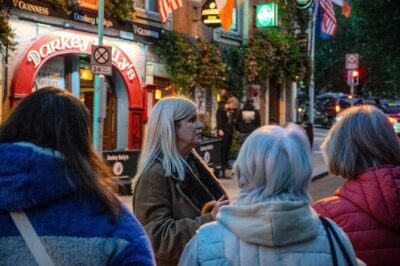
The tour begins at 8pm near the Church Bar on Jervis Street. That start time matters. Dublin’s streets may still be active, but the fading light changes how you see the Northside’s alleys, old walls, and narrow streets.
Your guide begins with a short introduction to Dublin’s haunted past before leading the group into the area once known as Oxmantown. This was a former Viking enclave and one of the oldest parts of the city. The setting gives the evening some weight before the first ghost story arrives. You are not simply being taken from one spooky doorway to another. You are walking through a district shaped by medieval religion, rebellion, poverty, crime, and political violence.
I like this approach because the supernatural tales work better when you know the people and places behind them. The stories are tied to real streets and buildings, not just vague legends. Several guides, including Calum, Darragh, Aisling, and Derrick, have been praised for making the historical material clear, lively, and easy to follow.
The group can reach up to 55 people, so the experience may not always feel intimate. Smaller groups have been described as comfortable, but you should be prepared for a larger gathering on a busy evening. Stay close enough to hear the guide, especially at street corners and open areas.
More Ghost Walking Tours in Dublin:
- Haunted Dublin Walking Tour
★ 5.0 · 550 reviews - Dublin’s Haunted History Walking Tour
★ 4.3 · 345 reviews - Hidden Dublin: Haunted History Walking Tour v2.0 2026
★ 4.5 · 188 reviews
Croppie’s Acre and the uneasy ground of rebellion
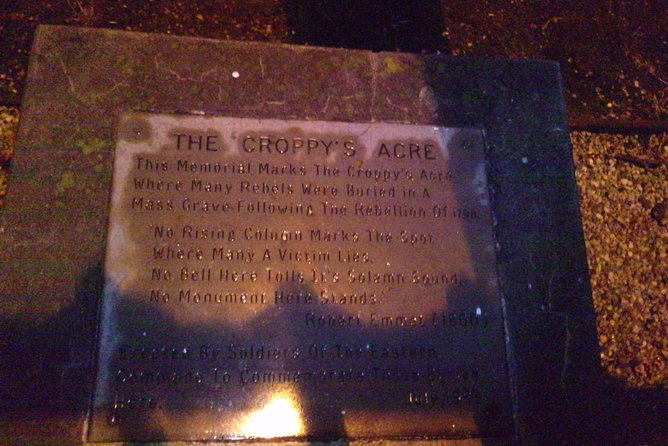
One of the most unsettling stops is Croppie’s Acre. The site was used as a football pitch during the 20th century, but beneath it lies a mass grave containing hundreds of rebels executed after the 1798 rebellion.
That contrast gives the stop its force. A familiar recreational space once covered a place of death. The tour uses this tension to move from ordinary modern Dublin into a darker part of Irish history. You may hear that spirits attempt to communicate here, but the historical fact alone gives the location an uneasy atmosphere.
This is not a polished monument with a long explanation panel. It is a place where the past can be easy to miss if you do not know what happened there. The guide helps you notice what an ordinary passerby might overlook.
If you are sensitive to stories about executions or mass graves, Croppie’s Acre may be the most disturbing part of the walk. I would not choose this tour for a young child simply because it sounds spooky. The minimum age is 10, and children must be accompanied by an adult, but parents should decide how comfortable their child is with murder, torture, and death.
St. Mary’s Abbey, hidden in plain sight
The route continues toward the remains of St. Mary’s Abbey, a monastic settlement that was once among the most powerful in medieval Ireland. Today, only a small ruin remains down an alleyway, passed by thousands of people who may never notice it.
This is one of the tour’s best ideas: using a modest-looking site to explain how much of Dublin’s past survives in fragments. The abbey is not presented as a grand, complete ruin. Its appeal comes from the setting and the sense that a major religious center has been reduced to a small, quiet trace among modern streets.
The guide’s explanation gives the stop its purpose. You hear about the abbey’s place in medieval Dublin, then connect that past with the stories of people who later lived, suffered, or died in the same part of town.
I especially like this stop for people who enjoy finding overlooked corners of a city. The tour is not only about ghosts. It gives you a reason to pay attention to side streets and small remains that you could easily walk past during the day.
Lord Norbury and the trial of Robert Emmet
The story of Lord Norbury adds a political edge to the evening. He was the infamous hanging judge who presided over the trial of Robert Emmet and became hated for his harshness.
The tale does not stop with Norbury’s life. The ghost story says that, after death, he returned to continue his reign of terror. That blend of historical cruelty and supernatural punishment is typical of the tour. The guide gives you the real setting first, then adds the legend that has grown around it.
Robert Emmet’s story appears as well. According to local legend, he can still be seen peering from a window at the Brazen Head, watching those who approach and deciding if they are friend or foe.
These tales work best if you enjoy the overlap between history and folklore. If you want a polished horror show with frequent surprises, you may find the pacing too calm. If you like learning why a ghost story exists, the political background makes the material more interesting.
The guides are a major part of this section. Darragh has been praised for his enthusiasm and clear explanations, while Calum is known for adding lesser-known facts and lively comparisons between Dublin’s past and present. Those personal touches help keep the material from feeling like a lecture.
Other ghost walks and hunts we rate around Dublin
- Dublin Ghost Bus Tour with Professional Actors
★ 4.5 · 949 reviews - From Dublin: Gravedigger Ghost Bus Tour
★ 4.4 · 546 reviews - Gravedigger 2-Hour Ghost Bus Tour From Dublin
★ 4.5 · 501 reviews - Dublin: North Quay Guided Ghost Walk
★ 4.2 · 144 reviews
Scaldbrother, Billy the Bowl, and Dublin’s criminal legends
The route also introduces Scaldbrother, a medieval thief whose buried treasure is said to remain somewhere in the maze of chambers beneath Smithfield. The underground setting adds a classic treasure legend to the tour, even if you do not enter the tunnels.
Then comes Billy the Bowl, an 18th-century murderer born without legs who terrorized Stoneybatter and Grangegorman. His story is grim, unusual, and very different from the tales of judges, rebels, and monks.
These characters help widen the tour beyond the standard haunted-house formula. You hear about people who became feared because of what they did in life, not only because their spirits supposedly lingered after death.
I would describe the tone as dark history with supernatural elements rather than a nonstop scare attraction. One person could enjoy the history but feel that there were not enough ghost stories or traditional Irish folklore involving banshees and fairies. That is a fair expectation to set before booking.
The tour’s appeal depends heavily on storytelling. Calum, Darragh, Aisling, and other guides have been praised for being friendly, funny, and willing to answer questions. A strong guide can make an old criminal legend memorable. A less engaging presentation would leave the same material feeling thin.
Hendrick Street and the vanished haunted houses
The most focused ghost section comes on Hendrick Street, once home to two of Dublin’s most haunted houses. Numbers 7 and 8 were said to contain six different ghosts between them.
The houses were demolished in the 1960s, so you will not enter a preserved haunted building. Instead, the guide explains what once stood there and why the site gained such a reputation. That absence is part of the story. The ghosts may be gone from the buildings, but the legend remains attached to the street.
This stop works for people who enjoy the idea that a location can retain its atmosphere even after its original structures disappear. It also shows one limitation of a city ghost walk: many of the most famous places are no longer intact. You need to enjoy description and imagination, not expect a theatrical set.
The route down Hendrick Street comes beneath the cover of darkness, which gives the story more mood than it would have in daylight. Still, the experience remains a walking talk rather than a haunted-house attraction. You will not be locked in rooms, chased by actors, or subjected to special effects.
The walk itself, pace, and physical effort
The stated duration ranges from about 1 hour 20 minutes to 2 hours, with the route generally ending around 10pm at the Brazen Head. Several stops involve walking between districts, so this is not a short series of talks in one small area.
You should wear comfortable shoes. The route covers Dublin streets at night, and one portion of the walk back to your accommodation may add more distance afterward. If you have already spent all day walking around Dublin, save some energy for the evening.
One useful benefit of the moving route is that you see parts of the city you might otherwise miss. The walk connects Jervis Street, Oxmantown, St. Mary’s Abbey, Smithfield, Stoneybatter, Grangegorman, Hendrick Street, and the area near the Brazen Head. You get a broader view of Dublin’s Northside than you would from a single pub-based storytelling session.
The tradeoff is that the tour cannot stop at every interesting place. Some people may wish for more stops and more stories along the way. The guide has to keep the group moving, cross streets safely, and finish at a reasonable time.
The Brazen Head is a useful finish
The tour concludes at the Brazen Head, at 20 Bridge Street Lower near Usher’s Quay. This gives the evening a natural ending, especially if you want food or a drink afterward. Food and drinks are not included, so plan to pay separately.
The Brazen Head also connects to the Robert Emmet story, with the legend that Emmet can be seen looking from one of its windows. That makes the final stop feel tied to the tales you heard earlier rather than simply being an arbitrary endpoint.
The end point is not the same as the start, so plan your route back to your hotel or onward destination. Dublin has public transportation nearby, and the tour is listed as close to public transport, but no hotel pickup or drop-off is provided.
Price, group size, and what you receive
The supplied price is listed as $0 per person, which makes the experience look unusually good value. Since tour prices can change, check the current booking details before you rely on that figure. At the stated price, you are paying for a local guide and a structured evening walk through several historic districts, while food, drinks, transport, and hotel pickup remain separate.
The value is strongest if you already enjoy walking tours and want a different way to see Dublin. You get local stories, historical context, and a nighttime route for roughly two hours. The value is weaker if your main goal is a high-scare experience with actors, sound effects, or indoor haunted sites.
The group maximum is 55 people. That is large enough to affect how easily you hear the guide, though the experience can still feel friendly when the group stays together. Mobile tickets are accepted, and the tour is offered in English.
Free cancellation is available up to 24 hours before the start time. If the minimum number of participants is not reached and the tour is canceled, you are offered another date or experience, or a full refund.
Who should book the North Quay Ghost Walk?
I would choose this tour if you like dark civic history, old streets, political stories, and folklore that grows out of real places. It suits someone who wants to see a less obvious side of Dublin and does not mind walking for most of the evening.
History fans may enjoy it as much as people who like supernatural tales. The guides explain the background of Dublin’s buildings, rebels, judges, criminals, and religious sites, so the tour offers more than a string of ghost sightings.
I would hesitate if you want constant scares, a short route, or a visit inside several preserved haunted buildings. The tour can feel more like a dark history walk with ghosts than a pure ghost tour. The lack of banshee and fairy stories may also disappoint anyone seeking traditional Irish folklore.
Should you book it?
Book the North Quay Ghost Walk if you want an entertaining introduction to Dublin’s darker past, especially if you can handle a long evening walk and prefer stories grounded in real streets. Ask for or watch for guides such as Calum, Darragh, or Aisling if the booking system provides guide information, since the presentation style is central to the experience.
Skip it if you need a strong scare around every corner. For the right audience, though, the mix of Viking-era Dublin, Croppie’s Acre, St. Mary’s Abbey, rebel history, criminal legends, and haunted Hendrick Street makes this a worthwhile way to spend an evening.
FAQ
Where does the North Quay Ghost Walk start?
The tour begins at 8pm outside the Church Bar on Jervis Street in Dublin. The meeting information also identifies North City, Dublin 1, as the start area, so check your mobile ticket for the exact meeting instructions.
Where does the tour finish?
The walk ends at the Brazen Head, 20 Bridge Street Lower, Usher’s Quay, Dublin.
How long does the tour last?
The tour lasts approximately 1 hour 20 minutes to 2 hours and is expected to finish around 10pm.
What places are included on the route?
The route covers Dublin’s former Oxmantown district, Croppie’s Acre, the site of St. Mary’s Abbey, areas connected with Smithfield, Stoneybatter and Grangegorman, and Hendrick Street.
What stories are told?
You hear stories connected with Lord Norbury, Robert Emmet, Scaldbrother, Billy the Bowl, Croppie’s Acre, and the former haunted houses at numbers 7 and 8 Hendrick Street.
Is the tour suitable for children?
The minimum age is 10, and children must be accompanied by an adult. The stories include executions, murder, torture, rebellion, and ghosts, so adults should decide if the subject matter suits each child.
Is food or transportation included?
No. Food, drinks, hotel pickup, and hotel drop-off are not included. The tour begins and ends at different locations, although the route is near public transportation.
Freshly reviewed haunts around Dublin
- Macabre, Ghostly & Bloody Walking Tour★ 5.0 · 15 reviews
- Dublin Ghost Hunt Exploration Game and Tour★ 4.0 · 34 reviews
- Legends, Ghosts and Ghouls Walking Tour Dublin★ 4.5 · 16 reviews
- Hidden Dublin: Haunted History Walking Tour v2.0 2026★ 4.5 · 188 reviews
- Dublin: North Quay Guided Ghost Walk★ 4.2 · 144 reviews
- Dublin: Legends, Ghosts & Ghouls Walking Tour★ 4.6 · 7 reviews
- Dublin walking tour: ghosts & haunted places★ 4.9 · 55 reviews
- Dublin’s Haunted History Walking Tour★ 4.3 · 345 reviews
Dublin Ghost Tours, compared.


Hidden Dublin: Haunted History Walking Tour v2.0 2026
Read our review →
Browse the lists this tour appears in