
Review · JAPAN
Tokyo: True Crime And Ghost Stories Tour
Tokyo’s neon districts have a darker story beneath the bright signs. This three-hour walk takes you from Kabukicho’s red-light streets to Toyama Park, linked to the horrors of Unit 731, then into Aoyama Cemetery for Japanese ghost stories and the grave of Hachiko. It is part history lesson, part true-crime talk, and part theatrical spooky evening.
I like the way guide John connects crime and folklore to the city around you, rather than handing you a string of unrelated shocks. I also like the small-group feel, the clear passion for Japanese history, and his willingness to answer questions. The main drawback is the subject matter: sex, murder, war crimes, and adult humor are central to the evening, and the walk includes stairs and plenty of time on your feet.
Key points to know before you book
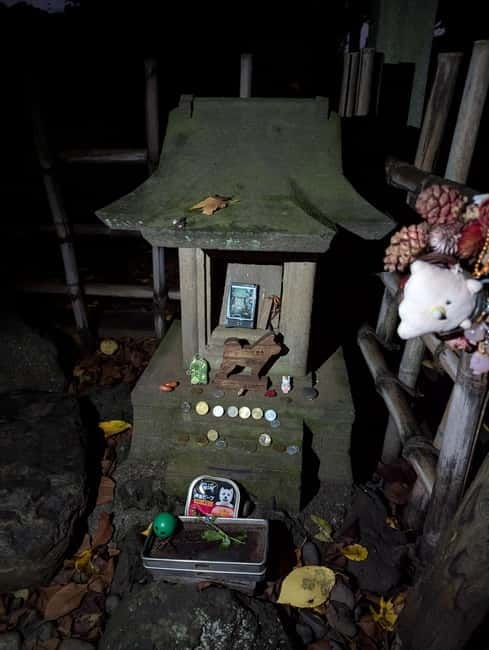
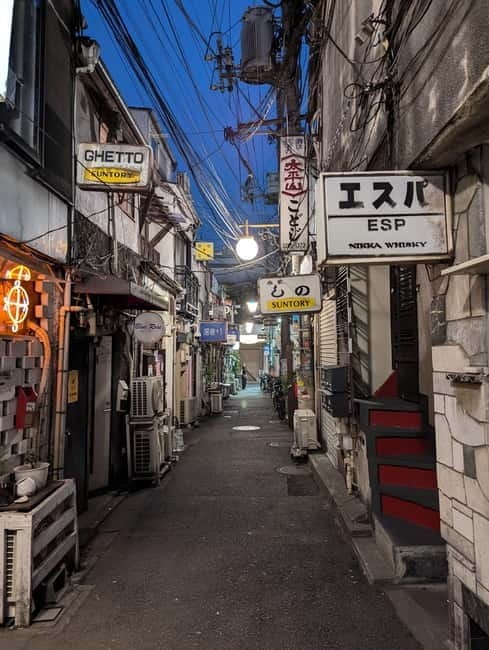
- Kabukicho sets the tone: Begin near Hanazono Shrine and Golden Gai, in Tokyo’s best-known red-light and drinking district.
- Toyama Park carries serious weight: The tour addresses Unit 731 and wartime human experimentation, not just spooky urban legends.
- Aoyama Cemetery supplies the atmosphere: Expect Japanese ghost stories in a dark cemetery, plus a visit to Hachiko’s grave.
- John is the heart of the experience: His lively acting, jokes, and wide knowledge shape the evening.
- Plan for a long walk: The route lasts three hours, includes stairs, and is not suitable for people with low fitness or wheelchair users.
- The price is modest: At $35 per person, the tour includes the guide, while transportation costs about 200 yen extra.
Starting beneath Hanazono Shrine near Golden Gai
The meeting point is just in front of the stairs leading to the main shrine building inside Hanazono Shrine. The shrine sits in Shinjuku, close to Golden Gai, so you begin in a very Tokyo setting: a quiet traditional space pressed against one of the city’s most famous nightlife areas.
You are told to look for John, described as a thin, bald white man, and to check your booking messages for any last-minute meeting details. That is useful advice in Shinjuku, where a few streets can look alike and the evening crowds can make a guide hard to spot.
The shrine is a good opening point because it places old Tokyo beside modern nightlife. You do not need an entrance ticket for the stops on the route, but you should arrive ready to walk. The tour does not include dinner, so eat beforehand or plan a meal after reaching Aoyama-Itchome Station.
John’s style is a major part of the evening. He is not presented as a solemn lecturer. His storytelling uses jokes, dramatic acting, and the occasional dark line, while still making room for serious historical context. That mix works well for some people and will feel too irreverent to others.
More Ghost Story Tours in the world:
- Prague: Ghost Walking Tour Where Legends Come To Life
★ 4.4 · 5,253 reviews - Prague: Ghosts, Legends, Medieval Underground & Dungeon Tour
★ 4.3 · 5,104 reviews - Prague: Ghosts and Legends of the Old Town Evening Tour
★ 4.5 · 3,091 reviews
Kabukicho: crime, nightlife, and Tokyo’s uneasy edges
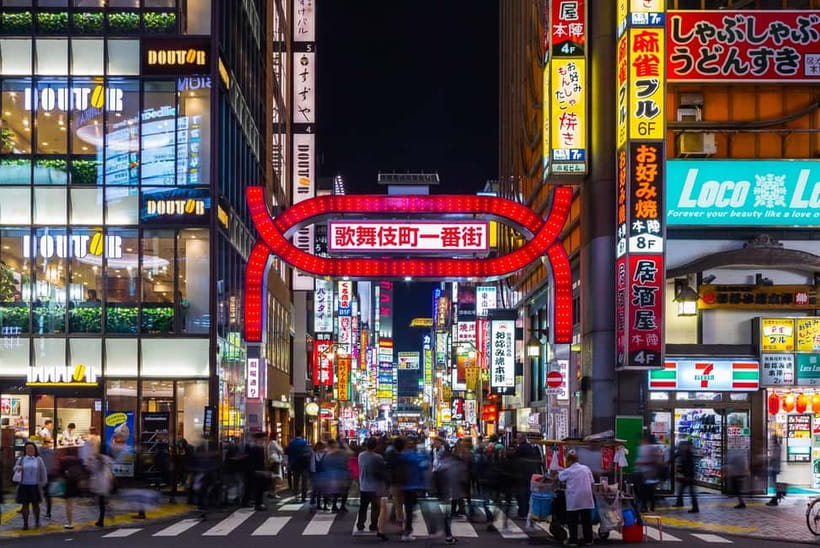
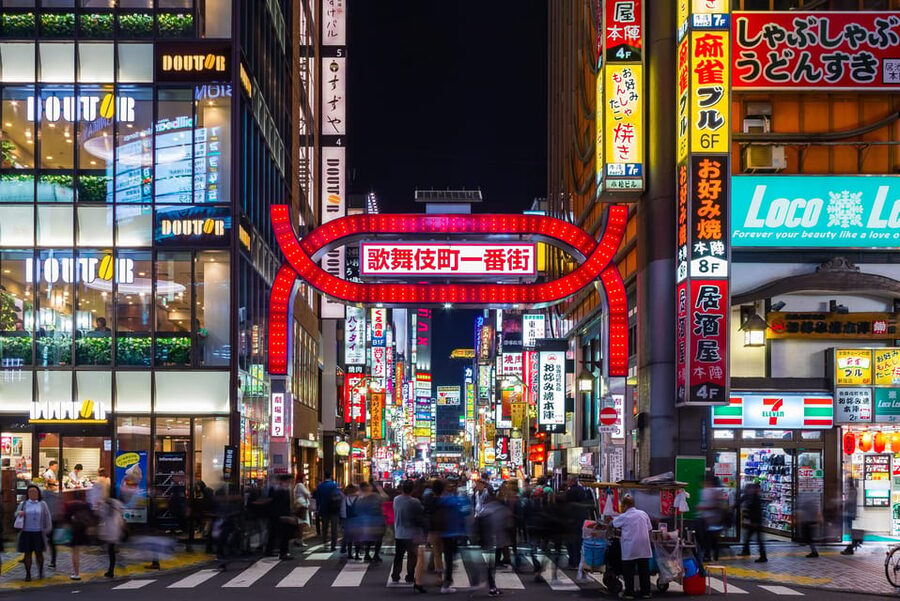
The first main section lasts about 45 minutes in Shinjuku. Kabukicho is Japan’s largest red-light district, though the area is also famous for restaurants, bars, clubs, entertainment venues, and huge illuminated signs. The tour uses this setting to explain organized crime, gang disputes, murders, troubled relationships, and the city’s quasi-legal sex industry.
This is not a tour of ordinary sightseeing landmarks. You are looking at streets where nightlife, money, status, and risk overlap. John’s stories give you a way to read the district beyond its bright signs. Instead of seeing Kabukicho as a place built only for entertainment, you begin to notice the social machinery behind it.
The tone can shift quickly. A grim crime may be followed by a silly joke, then by an explanation of how a neighborhood developed. Several people who enjoyed the walk valued this balance, since a full evening of violent stories could become exhausting. The humor is also adult and sometimes dirty, so this is not a family activity.
You should be comfortable discussing prostitution, sex clubs, love hotels, murder, and organized crime in public. Children under 14 are not allowed, and even older teenagers may not be a good fit if these topics would make the group uncomfortable.
One useful strength is the chance to ask questions. John’s role is not limited to reciting prepared stories. He also answers broader questions about Japan and its past, which can make the Kabukicho section feel more like a conversation than a stage performance.
Toyama Park and the weight of Unit 731
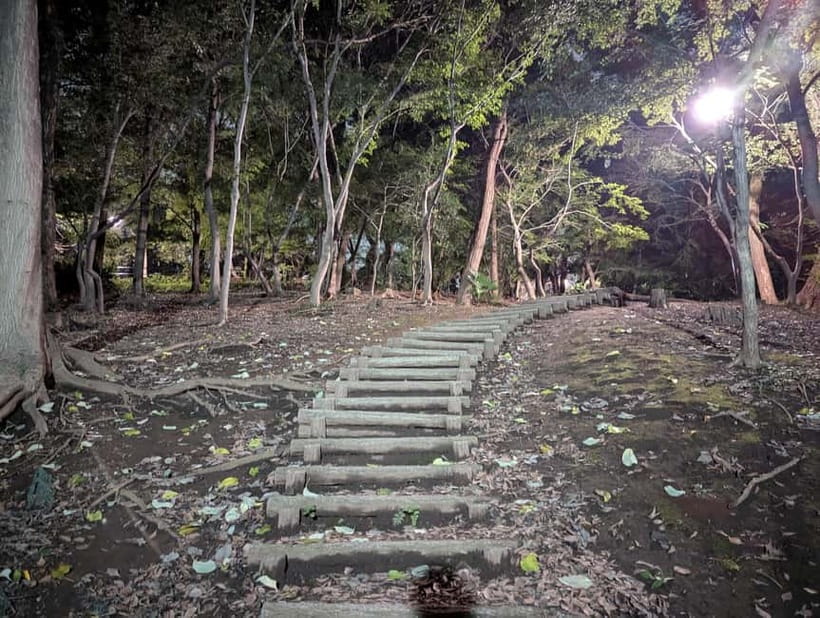
The route then continues on foot to Toyama Park, with about 30 minutes devoted to the site and its history. This is the point where the evening becomes more serious. The park is associated with Unit 731, the wartime Japanese military organization known for human experimentation.
The tour presents Toyama Park as a place connected to terrible crimes against humanity. Calling it Tokyo’s mini-Auschwitz is blunt and emotionally loaded, but it signals the kind of material you will hear. This section is not ghost entertainment. It asks you to consider how a pleasant public space can carry memories of violence that are often left out of the usual city tour.
I value this part because it broadens the meaning of a dark-history walk. You are not simply collecting frightening stories. You are also hearing about wartime crimes and the ways difficult subjects can disappear from public discussion. The subject deserves a respectful tone, and John’s historical focus matters here.
At the same time, the tour is openly irreverent. The guide’s humor may help some people stay engaged, but it may feel out of place when the topic turns to human experimentation. If you want a strictly academic presentation of wartime history, this is probably not the right format. If you can handle a talk that moves between gravity and dark comedy, the contrast is part of the experience.
Expect more walking between stops, and do not count on the route feeling like a short stroll. The activity information warns that people who tire easily should skip it. One person specifically noted the stairs, while another suggested beginning earlier so the cemetery could be seen in fading daylight. That is practical advice: choose a comfortable pace, wear sensible shoes, and consider how you feel after a full day in Tokyo.
Aoyama Cemetery after dark
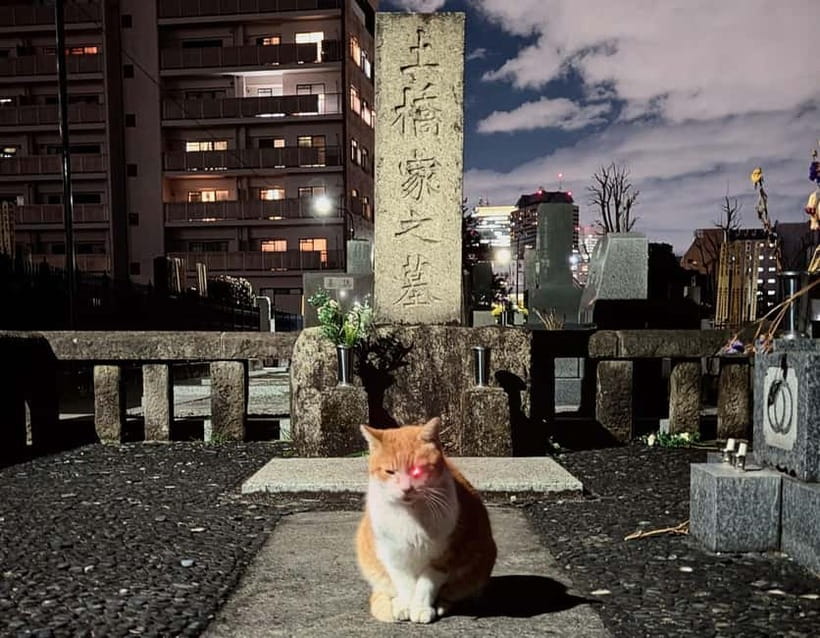
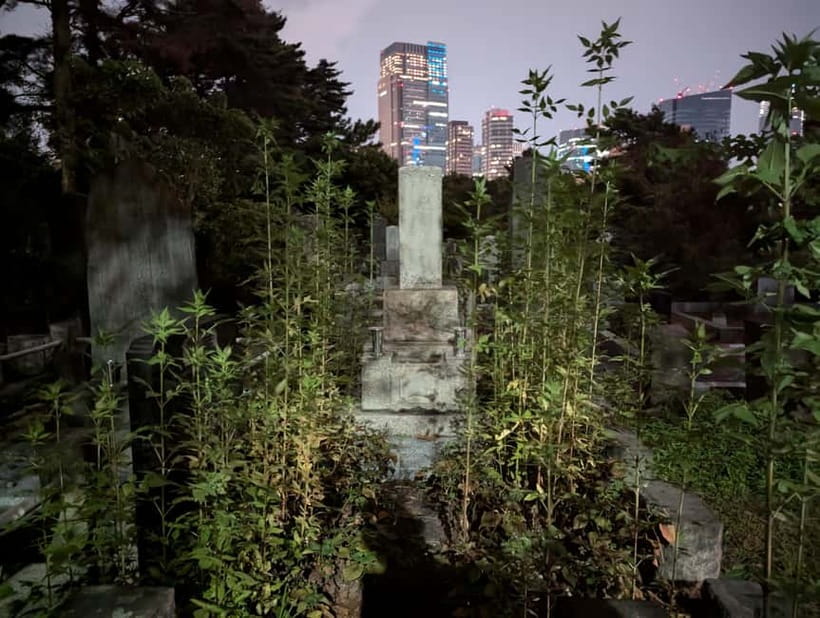
The final major section lasts about 45 minutes at Aoyama Cemetery, the largest cemetery in Tokyo. By this point, the city’s bright commercial side feels far away, even though you remain in central Tokyo. The cemetery provides a natural setting for Japanese ghost stories, and the evening timing adds atmosphere.
This is where John’s acting comes into its own. His storytelling is described as expressive and theatrical, and the ghost tales are designed for suspense rather than a dry account of folklore. You may get a dramatic voice, an exaggerated pause, or a deliberately silly turn that breaks the tension.
The cemetery is also home to the grave of Hachiko, Japan’s famous loyal dog. That gives the final stop a softer note beside the darker stories. You are not only hearing about ghosts and crime. You are also seeing a memorial connected to one of Japan’s best-known stories of loyalty.
Aoyama Cemetery has one practical catch: if your tour starts late, you may see less of the cemetery itself. One attendee wanted an earlier start so the group could understand the setting before darkness. Check the available start times and think about what you prefer. A later tour may offer stronger spooky atmosphere, while an earlier one gives you more visual context.
The tour ends at Aoyama-Itchome Station. Transportation fees are not included, and the stated extra cost is about 200 yen. Since the activity ends away from its starting point, it helps to check your route home before you set off. John has helped people find their trains after the tour, but you should still keep your hotel address and station details handy.
More Dark History Tours in the world:
- Adults-Only New Orleans Ghost, Crime, Voodoo, and Vampire Tour
★ 5.0 · 6,545 reviews - Edinburgh: Dark Secrets of the Old Town Ghost Walking Tour
★ 4.6 · 1,671 reviews - New Orleans Adults-Only True Crime and Ghost Walking Tour
★ 5.0 · 1,666 reviews - Genteel and Bard’s Savannah Dark History and Ghost Encounter Walking Tour
★ 5.0 · 1,546 reviews
John’s storytelling is the main attraction
The stops matter, but John’s presentation determines how the evening feels. The strongest praise centers on his storytelling, humor, acting, and command of Japanese history. He is described as passionate, entertaining, and able to keep a group engaged even in heat, humidity, rain, or after a long day of walking.
That matters because the tour covers material that could become grim or repetitive. John uses jokes to release tension, then returns to the facts. He also includes side stories and answers questions, so the experience can feel personal rather than mechanical.
His personality is unusual. You may find him quirky, theatrical, or slightly chaotic, including his joking struggle to count stairs. That will appeal to people who want a guide with a strong character. It may not suit you if you prefer a quiet, formal presenter who sticks closely to a script.
The private-group option is worth considering if your group has specific interests or different comfort levels. The tour is available in English, and private booking may make it easier to ask questions or set the tone. The supplied details do not promise a particular group size for the standard booking, so check the current availability if group size matters to you.
What the $35 price buys you
At $35 per person, this is fairly priced for a three-hour guided walk in central Tokyo. The fee covers the guide and the route itself. There are no entry charges at the listed stops, so you are mainly paying for John’s research, storytelling, local orientation, and the structure that ties the neighborhoods together.
The value is strongest if you already enjoy true crime, ghost stories, wartime history, or unusual city walks. You get several themes in one evening: nightlife and organized crime in Kabukicho, wartime atrocities at Toyama Park, and folklore in Aoyama Cemetery.
It is less useful if you want famous temples, food tastings, shopping advice, or a broad introduction to Tokyo. This is a narrow subject tour, and it stays focused on the city’s darker side. You also need to budget about 200 yen for transportation, plus any food or drinks you buy before or after.
The free-cancellation policy allows cancellation up to 24 hours before the activity for a full refund. You can also reserve and pay later, which helps if your Tokyo plans are still changing.
Who should book this walk
I would choose this tour if you enjoy crime documentaries, horror stories, Japanese folklore, or difficult historical subjects. It also suits repeat visitors who have already seen the standard Shinjuku sights and want a more unusual way to understand the city.
It can work for people who are not horror fans, too, as long as they are comfortable with murder, sexual themes, and war crimes. Several parts are historical rather than supernatural, and the tour offers context about Japanese society and wartime Japan.
You should skip it if you tire easily, dislike stairs, or want a gentle evening. Wheelchair users cannot be accommodated on the stated route, and anyone over 300 pounds, or 136 kilograms, is listed as unsuitable. The walking, darkness, adult language, and sensitive material are not minor details. They shape the entire experience.
Final verdict: book it for the stories, not the sightseeing
Book this tour if you want Tokyo explained through crime, memory, folklore, and places most standard walks ignore. The best reason to go is John’s animated delivery and the unusual range of subjects, from Kabukicho’s nightlife economy to Unit 731 and ghost stories in Aoyama Cemetery.
Skip it if you want a polished, gentle, family-friendly tour. For the right audience, $35 buys an entertaining and thought-provoking evening that may change how you see several familiar parts of Tokyo. Just wear good shoes, eat first, and arrive ready for a walk that gets serious before it gets spooky.
FAQ
How long is the Tokyo True Crime and Ghost Stories Tour?
The tour lasts three hours.
Where does the tour begin?
It begins at Hanazono Shrine in Shinjuku, just in front of the stairs leading to the main shrine building. The meeting point is near Golden Gai.
Where does the tour finish?
The walk finishes at Aoyama-Itchome Station.
What language is the tour offered in?
The tour is conducted in English by a live guide.
Are transportation and food included?
Transportation is not included. The stated transportation cost is 200 yen. Dinner and other food are also not included.
Is the tour suitable for children?
No. Children under 14 are not permitted, and the tour includes adult language, sexual topics, murder, war crimes, and dark humor.
Freshly reviewed haunts around the world
- New Orleans French Quarter Dark History, Haunts, and Laughs Tour★ 5.0 · 30 reviews
- New Orleans’ Finest Haunted Pub Tour★ 4.5 · 38 reviews
- Cheers New Orleans! Cocktails, History, Voodoo & Paranormal Tour★ 4.0 · 4 reviews
- Haunted Drunken History Tour from New Orleans★ 5.0 · 135 reviews
- The Original Asbury Park Ghost Tour★ 4.5 · 29 reviews
- Destrehan Plantation Haunted Night Tour★ 4.5 · 100 reviews
- New Haven’s Ghost Walk★ 3.5 · 69 reviews
- Ghosts of Tonopah Haunted History GPS/APP Smartphone guided Walking Tour outside★ 4.5 · 7 reviews
Japan Ghost Tours, compared.

Kyoto Ghost Tour: Dark Tales, Urban Legends, Bamboo Forest Night
Read our review →
Tokyo: Ghost Tour with Scary Japanese Stories and Folklore
Read our review →
Browse the lists this tour appears in